The Doorpost Test: When Faith Becomes Visible
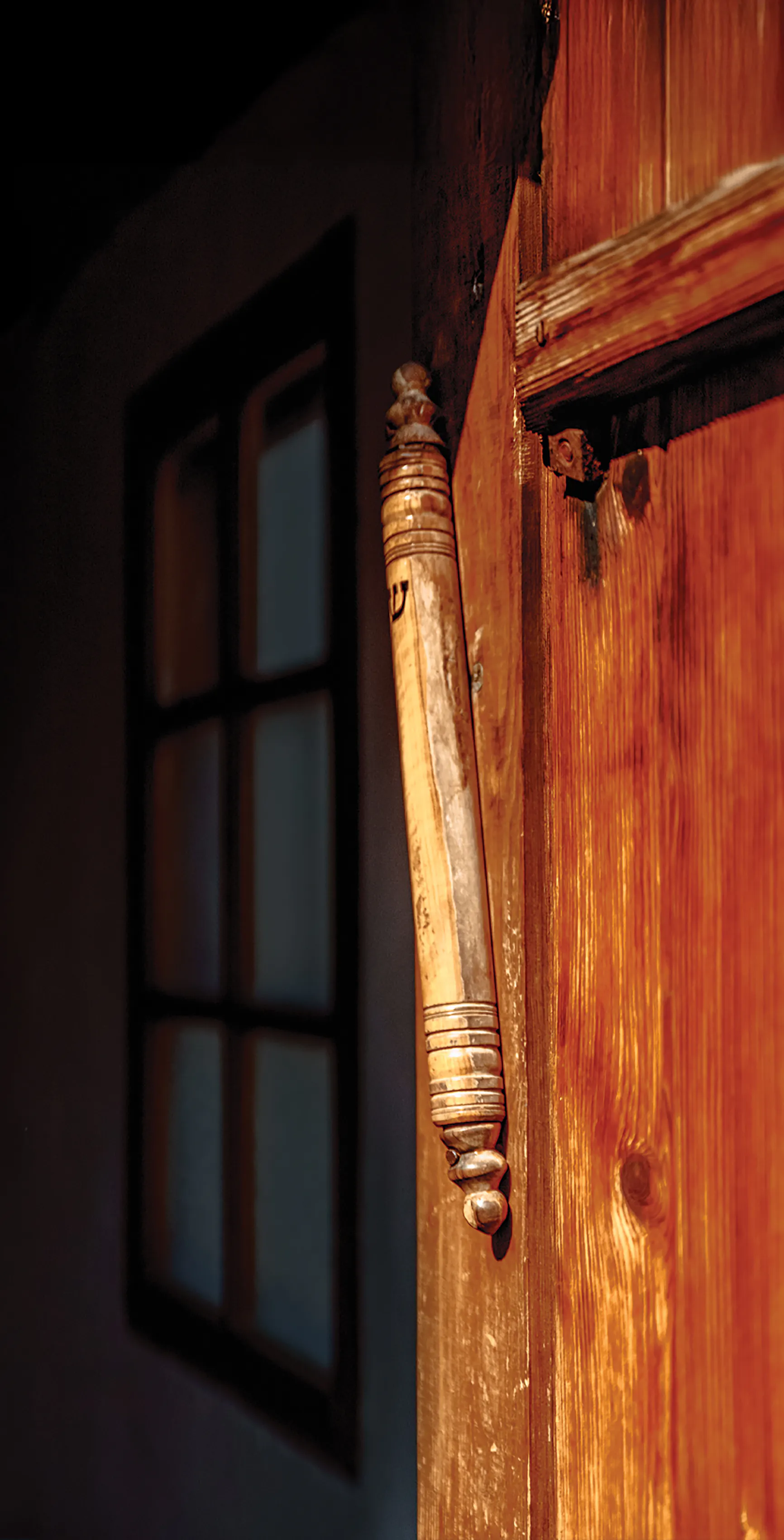
On the doorposts of Jewish homes around the world, on the right-hand side as you enter, you will find a small case of wood, metal or stone, placed at a slight angle. It is called a mezuzah, the Hebrew word for “doorpost.” Many Jews touch it as they pass through and then kiss their fingertips.
Inside the case is a small scroll of parchment carrying 15 verses of Torah (Gen.–Deut.): Deuteronomy 6:4–9, known as the Shema, and Deuteronomy 11:13–21. Together they make up about 170 words and 713 letters, handwritten by a trained scribe, a sofer, on 22 carefully scored lines.
Fifteen verses; 107 words; 713 letters; 22 lines. All on one doorpost.
These verses open with one of the most foundational declarations in Scripture: “Hear, O Israel: The Lord our God, the Lord is one!” (Deut. 6:4). The command follows at once: “You shall love the Lord your God with all your heart, and with all your soul, and with all your strength” (Deut. 6:5). Then comes the instruction to teach these words to one’s children, to speak of them throughout the day, and finally: “You shall write them on the doorposts of your house and on your gates” (Deut. 6:9).

That last directive is what makes the mezuzah so striking. God did not simply tell Israel to remember; He told them to write. And He did not keep His words in the sanctuary; He placed them at the threshold of the home. It is a theological interruption. Every time you come home, you pass the words of God. Every time you step out into the world, you pass them again. The message is plain: don’t leave your faith at the door.
From the Heart to the Doorpost
Especially from the Middle Ages on, the mezuzah came to be seen not only as a reminder of God’s commandments but also as a source of protection. Yet the biblical text asks for something deeper. Deuteronomy 6 doesn’t begin with a scroll on the outside of the house. It begins with undivided love for God, engaging the whole person: heart, soul and strength.
From there, faith moves outward:
- The inner life: God’s words take root in the heart and mind, shaping desires, ethics and values.
- The next generation: What lives in a parent’s heart is taught intentionally to the children.
- Daily rhythm: Faith enters ordinary conversation, at home and on the road, lying down and rising up.
- The threshold: Only then does faith reach the doorposts and gates.
Love. Heart. Family. Conversation. Home. Doorpost. The order is intentional. The mezuzah is not where biblical faith begins; it is where inward faith becomes visible. The parchment doesn’t sanctify the people inside; its words are meant to shape them. It is entirely possible to have a mezuzah on the door and none of God’s words in the heart.
The Cost of Visibility
God did not tell Israel to hide these words in an inner room but to post them at the entrance, because real faith eventually steps into the light. A mezuzah tells everyone who approaches: a covenant lives here.
But visibility carries a cost. A mezuzah doesn’t only proclaim faith; it identifies a Jewish home. In the past, and again today, that has made Jewish homes a target.
A Doorway in Lublin
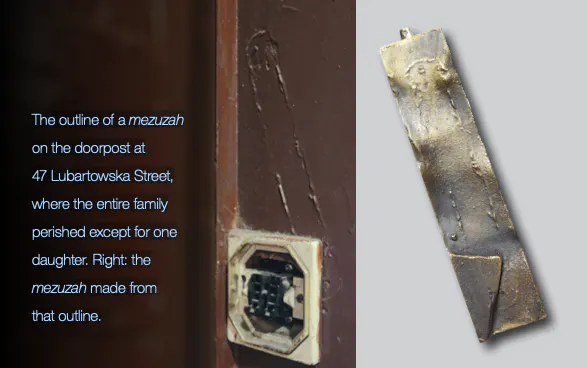
Recently, our global Bridges for Peace leadership team traveled to Germany and Poland on a Holocaust remembrance tour. In Warsaw, our guide took us to the Mi Polin Mezuzah Center. Its artists search Poland for homes where Jewish families lived before World War II. Where they find one, they take an impression of the spot on the doorframe where the mezuzah once hung, and from that impression they cast a new mezuzah.
My wife and I bought a large mezuzah as a gift for our family. It was cast from a doorframe at 47 Lubartowska Street in Lublin, and the artists told us who had lived there: the Fiszman-Sznajdman family.
A few days later, in Lublin, we used our lunch break to find the address. Imagine our wonder at standing before the very doorframe where the Fiszman-Sznajdman family had lived, and where our mezuzah’s impression was taken. Apart from one daughter, the entire Fiszman-Sznajdman family perished during the war, along with almost the entire immediate and extended family.
Before the war, about 40,000 Jews lived in Lublin, roughly a third of the city. An estimated 230 of them survived the Holocaust.
Christians and the Doorpost
So what does the mezuzah mean for Christians? Perhaps more than we have allowed it to. The mezuzah belongs to Jewish covenantal life. But Christians may choose to display one for a different reason: solidarity.
At a time when Jews are once again being told to hide who they are, perhaps Christians could consider making Jewish identity visible on their own homes. Not as an attempt to become Jewish, but as a public declaration: You are not standing alone.
A mezuzah on a Christian home can be a tangible act of friendship. It can say:
- We honor the Scriptures that came to us through Israel.
- We stand with the Jewish people.
- We will not let antisemitism decide which identities are safe to display.
Invisible solidarity is easy. Solidarity that crosses the threshold and becomes visible is different. So perhaps the question for Christians isn’t only, “What does the mezuzah mean?” Perhaps it is, “What would it mean if one were on my door?”
The mezuzah is only a small piece of parchment. But sometimes the smallest symbols make the loudest declarations.
Related Resources


Discover Your Purpose and God’s Heart For You
In today's divided, turbulent world, it's essential for the Church to rediscover God's heart. Our free e-book, authored by a seasoned expert with three decades of experience in Israel, delves deep into the teachings of Jesus (Yeshua) to reveal God’s principles of love and purpose. Learn how embracing these truths can bring significance and impact to your life, even amidst chaos. Subscribe now to receive your free copy and embark on a journey of transformation.