The Heart of a Faithful Jew
Moshe Kempinski and his brother Dov founded Shorashim in 1986 in the Jewish Quarter of Jerusalem’s Old City. More than a shop, it is a place where visitors from around the world come to discuss and study the Bible, Judaism, and Israel. Here, Moshe shares how Christians can connect more meaningfully with Jewish people. For a deeper discussion, read his book The Heart of a People. Out of respect for Orthodox Jewish tradition, this article uses “L-rd” and “G-d."
Talking to Christians about the heart of a faithful Jew is difficult, because we so thoroughly misunderstand one another. For generations, Jews kept Christians at arm’s length, wary of anything that came to them in the name of the Church, however kindly it was offered. A verse in your own New Testament, one I truly love, helps explain why: “For the tree is known by his fruit” (Matt. 12:33). The fruit we have tasted from Christianity through the centuries has been anything but sweet. As an old Jewish saying puts it, “I don’t want to taste of its bitterness, so I won’t taste of its sweetness.”
It can work the other way, too. You might hear accurate things about Jews, yet understand them through your own Christian definitions.
My brother and I opened our shop as a place to sanctify G-d’s name. Around 1990, something unexpected happened: Christians began searching out their Hebraic roots. A trickle came in, then pastors, then whole groups. We shut the door and we talk.
Some come to bless Israel, some to evangelize, but those are only G-d’s pretexts for bringing you here. You don’t come to Israel to bless Israel; you come to be blessed. You don’t come to change Israel; you come so that Israel can change you.
Same Words, Different Meanings
We use the same words, but we don’t mean the same things. A Christian asks a Jew, “Do you have a relationship with G-d?” The Jew hesitates: “I hope so.” The Christian concludes he is stuck under the law, and never asks the next question:
“Do you love G-d?”
“With all my heart, all my soul, and all my might.”
“Is G-d part of your life?”
“Every part of it. I wake up with him, I go to sleep with him, I dance with him, I cry with him, and I sing with him.”
Jews avoid the word “relationship” because it implies equality with G-d. We don’t disagree. We just don’t share a vocabulary.
The same is true of heaven. Ask a Jew whether he believes in heaven, salvation and eternity, and he will say yes. But they are not the focus of his life. The focus is this: G-d, am I cleaved unto you? Am I walking with you? Heaven is the by-product of a life lived with and for G-d, not the reason for it.
Or take the phrase “G-d told me.” To a Jew, it implies that there are times when G-d is not speaking. The truth is that G-d is always speaking; we are not always listening. If you leave Israel having learned to listen, you will hear him everywhere from everyone, from a taxi driver to a falafel seller.
A Gift of Love
Judaism holds seemingly opposite things together, such as the love and the fear of G-d. It’s too easy to love G-d and lose the fear, or to fear him and lose the love. In our prayers we call him Avinu Malkeinu, “Our Father, our King.” Another is faith and works, which for us are inseparable. Our faith is expressed in our works, and our works draw us into deeper faith.
Many Christians assume that Jews keep the commandments to earn heaven. If I know my wife desires something, there is no greater gift I can give her. If G-d, whom we love, says, “These are the things I desire,” then I want to do them forever.
A pastor once wrote to me after visiting Jerusalem during Sukkot (Feast of Tabernacles). He had watched one man measuring a palm branch with a ruler and another checking a citron for blemishes with a magnifying glass. “You’ve added all these man-made laws,” he wrote, “and you’re forgetting about G-d.”
I wrote back: “You may be right that G-d doesn’t care if the palm branch is a little bent or the citron has a blemish. But these aren’t G-d’s gifts to us. These are my gifts to G-d! I want them to be the most perfect palm branch and citron He ever created.”
Wrapped in His Presence
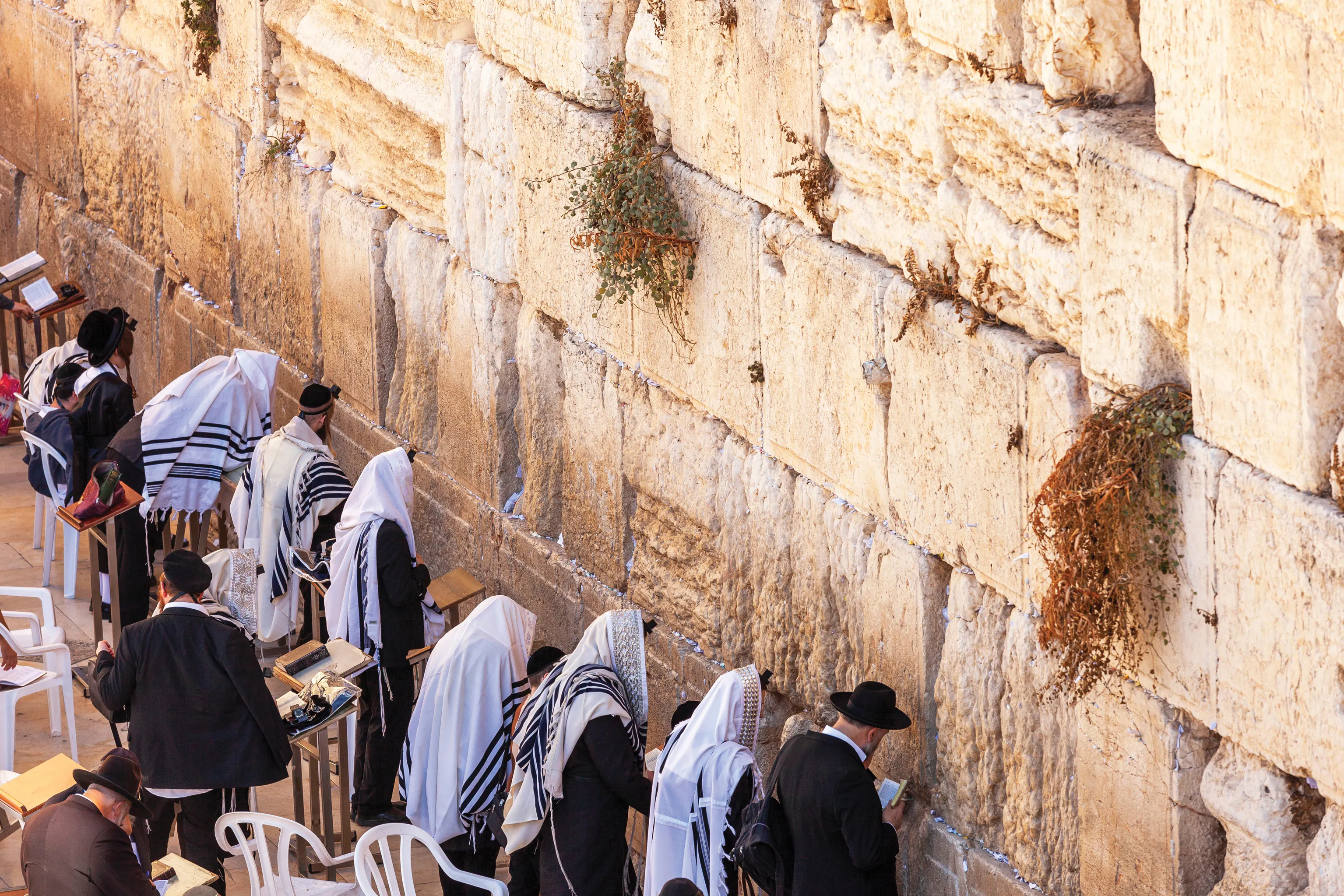
Consider the prayer shawl. Its fringes, commanded in Numbers 15, remind us of all G-d’s commands: the numerical value of tzitzit (fringes), plus the eight strings and five knots, adds up to 613, the number of commandments in the Torah (Gen.–Deut.).
To be wrapped in the prayer shawl is to be enveloped in the Shechinah, G-d’s divine glory and presence. That is our purpose: to be a vessel of His presence, here and now. Inside the shawl, no one is watching. You are in the cleft of the rock where G-d placed Moses, just you and Him. We pray in a congregation, but we pray alone together.
Under the Sovereignty of G-d
In the end, it’s not about Israel. It’s not about us, and it’s not about you. It’s about the sovereignty of G-d. If you want to stand with Israel, love G-d with all your heart, soul and might, as we must too.
The change I have seen in Christians over the past decade or so is that you have put on a mantle of humility you weren’t wearing before. As you have changed, Jews are saying, “Oh, we can talk.” Through Bridges for Peace, I have watched trust grow with the Jewish community. Our paths, once centuries apart, are starting to touch.
Shalom, one of G-d’s names, means completeness: every piece of the puzzle coming together. That is exactly what I see beginning to happen. We are children of the same Father, and calling each other brother and sister is no longer an empty statement. One day, the barriers that have long stood between us will melt away like ice in the sun.
Related Resources




Discover Your Purpose and God’s Heart For You
In today's divided, turbulent world, it's essential for the Church to rediscover God's heart. Our free e-book, authored by a seasoned expert with three decades of experience in Israel, delves deep into the teachings of Jesus (Yeshua) to reveal God’s principles of love and purpose. Learn how embracing these truths can bring significance and impact to your life, even amidst chaos. Subscribe now to receive your free copy and embark on a journey of transformation.