Contraband from the Covenant Land
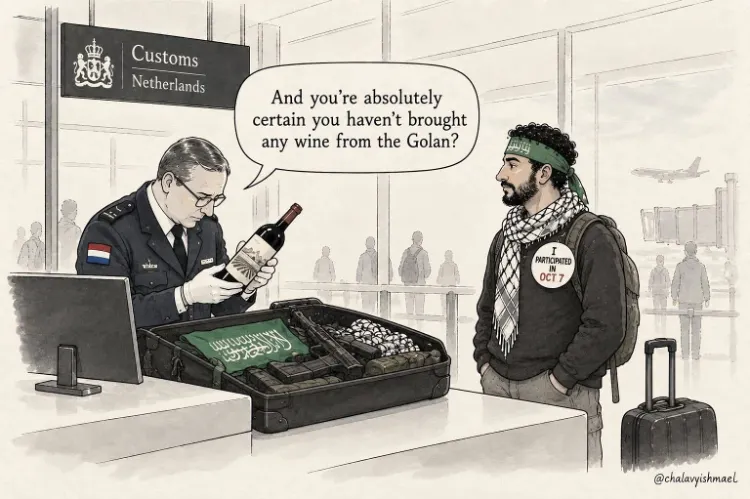
The customs officer holds a bottle of red wine up to the light, his brow furrowed in concentration. On the counter before him lies an open suitcase packed with a green Hamas flag, an assault rifle and several rounds of ammunition. The traveler waiting patiently sports a terrorist headband and a button proudly announcing, “I participated in Oct 7.” Yet the officer has more pressing concerns. “And you’re absolutely certain you haven’t brought any wine from the Golan?”
Israeli cartoonist Yehuda Teitelbaum drew the scene as satire. But since September 22, satire has crept uncomfortably close to reality at Amsterdam’s Schiphol Airport.
What Changed in the Netherlands
On that date, the Netherlands banned all goods “wholly or partly obtained or made” in Israeli communities in Judea, Samaria, eastern Jerusalem and the Golan Heights. The decree doesn’t stop at commercial shipments. It reaches right into the suitcases of ordinary travelers, covering souvenirs, gifts and items bought purely for personal use. Within days of the ban, passengers arriving from Tel Aviv reported luggage searches.
Consider what that means for the average Christian pilgrim packing for home after a tour of the Promised Land. A mezuzah or shofar bought in the Jewish Quarter of the Old City, a stone’s throw from the Western Wall, falls inside the forbidden zone. So does a box of Medjool dates from a Jewish farm in the Jordan Valley, a jar of mud from the northern shore of the Dead Sea and a bottle of olive oil pressed in the hills of Samaria.
The decree even catches goods made elsewhere if a single ingredient comes from the wrong side of the line. The product itself makes no difference. Only the address of its maker does. Olive oil pressed in an Arab village in Samaria passes through Schiphol untouched. Olive oil pressed a few kilometers away in a Jewish community is contraband.
Travelers carrying such items are instructed to head for the red “Goods to declare” line and surrender them. Those who don’t declare the items risk having them seized and an official report filed, with the public prosecutor deciding what happens next. The maximum penalty is six years in prison.
To determine what falls under the ban, customs officials work from a European Union (EU) list of postal codes covering every Israeli community beyond the 1949 armistice lines, often called the Green Line. These lines were never meant to be borders. They simply marked where the fighting stopped at the end of Israel’s War of Independence, with Jordan holding Judea, Samaria and eastern Jerusalem, including the Old City. On the northern front, the Golan Heights remained in Syrian hands. Israel regained all of these areas in the defensive 1967 Six Day War. However, in the eyes of the EU, every Jewish home, vineyard and factory built on the far side of those ceasefire lines since 1967 stands on unlawful ground.
The Netherlands isn’t alone. Spain introduced import restrictions last year; Ireland signed its own ban into law in July; Belgium and Slovenia have committed to follow suit. Each government points to the same justification: the July 2024 advisory opinion of the International Court of Justice, which declared Israel’s presence in Judea and Samaria unlawful and called on states to avoid trade that sustains it. Behind the court’s opinion stands Article 49 of the Fourth Geneva Convention and the EU’s long-standing “differentiation policy,” which draws a sharp line between Israel inside those ceasefire lines and everything it regained in 1967, including the Temple Mount and the Western Wall.
A Matter of Priorities
Consider the scale of what Europe is guarding against. According to Ireland’s own figures, its trade with Judea, Samaria and the Golan Heights—mostly fruit, vegetables and timber—amounted to less than €1 million across five years. The bans are a statement, and a costly one at that.
Yet the statement says far more than its authors intend. For three years, Europe has watched Iran fund, arm and train terror proxies on nearly every one of Israel’s borders. It has heard Hamas leaders promise to repeat October 7 again and again. And it has chosen to train its customs officers on a bottle of Cabernet from Katzrin, a small winemaking town on the Golan Heights. No other disputed territory on earth receives this treatment. Nobody returning from Northern Cyprus or Western Sahara is asked to empty their suitcase on a customs counter.
Neither does the ban serve the people it claims to champion. Thousands of Palestinian Arabs earn their living in Israeli industrial zones. When SodaStream closed its factory in 2015 under boycott pressure, some 500 Palestinian employees lost their jobs. Europe’s conscience was salved, and Palestinian families paid the bill.
The Heart of the Matter
Strip away the legal language, and the fixation isn’t about trade. It is about the land itself and the story written into its soil.
Judea and Samaria is the biblical heartland, the stage on which roughly 80% of the Old Testament unfolded. At Shechem, God promised the land to Abraham’s descendants (Gen. 12:6–7). At Bethel, Jacob dreamed of a ladder reaching into heaven. At Shiloh, the Tabernacle stood for 369 years, and a barren woman named Hannah poured out her heart before the Lord. In Hebron, Abraham bought the cave where the patriarchs and matriarchs lie buried. On the Golan, the ruins of ancient synagogues at Gamla and Katzrin testify to Jewish life there long before anyone drew a ceasefire line.
The prophets foresaw the day the Jewish people would return to these very hills and work the soil once more. “You shall yet plant vines on the mountains of Samaria; the planters shall plant and eat them as ordinary food” (Jer. 31:5). Ezekiel addressed the land directly: “But you, O mountains of Israel, you shall shoot forth your branches and yield your fruit to My people Israel, for they are about to come” (Ezek. 36:8).
Today, vineyards climb the slopes around Shiloh, olive presses run in the hills of Samaria and wines produced in the Golan win awards around the world. The bottle the Dutch officer holds up to the light is, in a very real sense, prophecy fulfilled.
Where the Promise Stands or Falls
Why all the intense focus on such a small plot of land? Because this is where God’s promise stands or falls. If the covenant people can be uprooted from the covenant land, if the vines Jeremiah foresaw can be legislated out of the world’s markets and confiscated from its suitcases, then the word of the God of Israel can be called into question. Of course the enemy has set his sights here. The attack always comes fiercest against the promise.
Yet the God who planted Israel back on the mountains of Samaria has never broken His word. Empires have tried to sever this people from this land before. Assyria carried Samaria into exile; Babylon burned Jerusalem; and Rome renamed the land itself to erase its Jewish memory. Each empire rose, each empire fell, and still the promise stands. Rest assured. A customs counter in Amsterdam won’t succeed where those empires failed.
Related Resources



Discover Your Purpose and God’s Heart For You
In today's divided, turbulent world, it's essential for the Church to rediscover God's heart. Our free e-book, authored by a seasoned expert with three decades of experience in Israel, delves deep into the teachings of Jesus (Yeshua) to reveal God’s principles of love and purpose. Learn how embracing these truths can bring significance and impact to your life, even amidst chaos. Subscribe now to receive your free copy and embark on a journey of transformation.