Charred Beams from Jerusalem’s First Destruction Speak Again
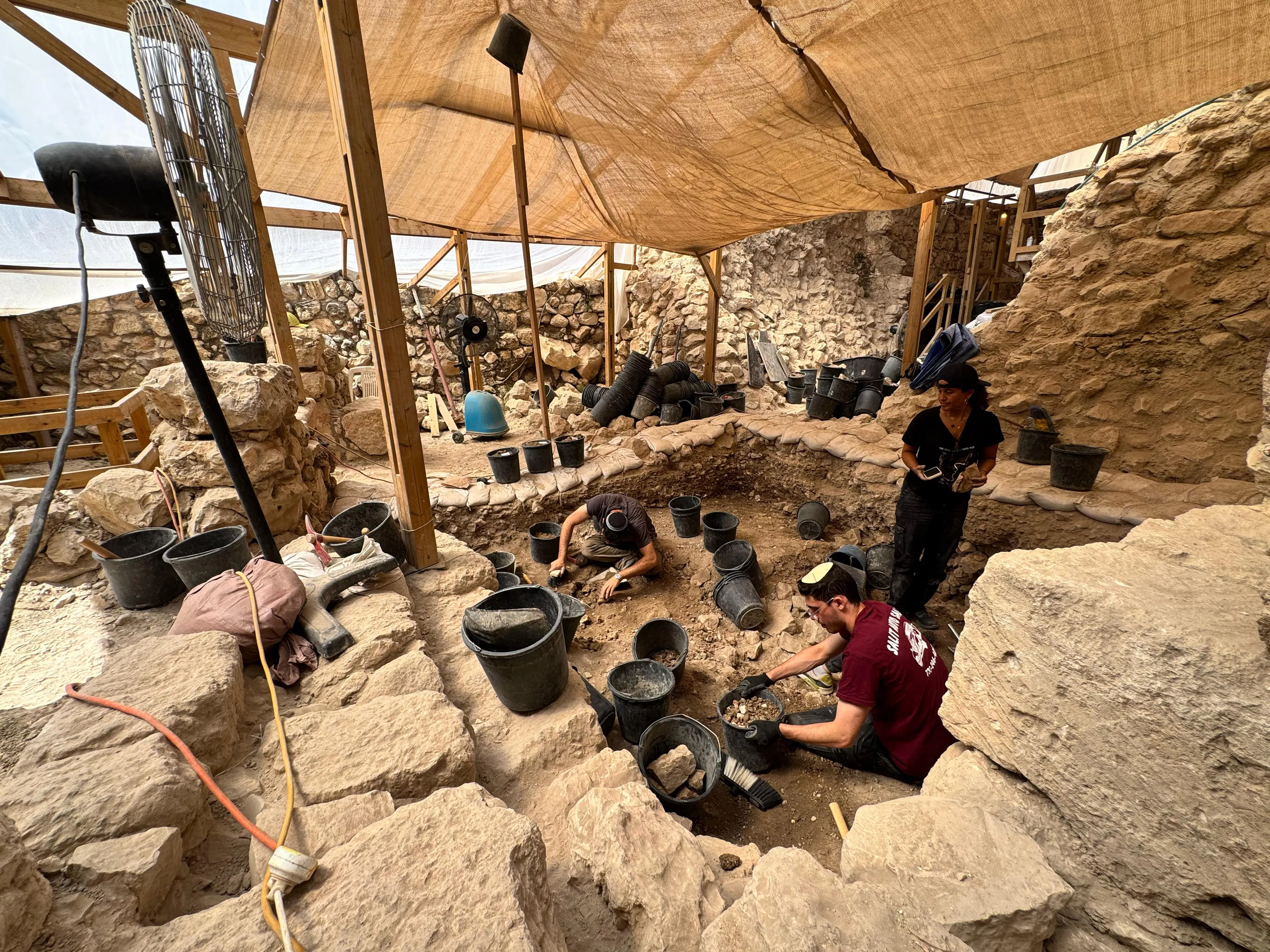
Beneath the Givati Parking Lot in Jerusalem’s City of David, archaeologists have pulled something remarkable from the earth: massive wooden beams, blackened by fire nearly 2,600 years ago, still bearing witness to the terrible day the First Temple fell.
The find comes from ongoing excavations by the Israel Antiquities Authority (IAA) and Tel Aviv University within the Jerusalem Walls National Park. Despite its unassuming name, the Givati Parking Lot—located just across from the City of David Visitor Center, south of the Old City’s Dung Gate and the Temple Mount—is one of the most active and significant dig sites in Jerusalem, having yielded discoveries spanning more than 2,500 years of continuous habitation in the Jewish capital.
The beams, made of sycamore wood, once formed the roof of an inner courtyard in a building from the First Temple period. When Babylonian forces burned Jerusalem in 586 BC, that roof collapsed in flame onto the floor below. There it remained, hidden for millennia…until recently.
Scripture teaches that King Solomon built the First Temple in Jerusalem in the 10th century BC, with God then promising to consecrate it, “to put My name there forever, and My eyes and My heart will be there perpetually” (1 Kings 9:3b).
Sealed by Fire, Preserved by Plaster
According to excavation director Efrat Bocher, the very fire that destroyed the building also preserved the evidence of its destruction. As the flames raged, plaster cladding on the building’s walls melted and flowed downward, sealing the charred beams beneath a protective layer. What was meant to devastate instead became the mechanism of preservation.
The scale of the find is what makes it exceptional. “It is very rare in Israel to find wood with such a large number of growth rings,” explains Dr. Johanna Regev of the IAA, a radiocarbon dating specialist who is studying the beams. Thick timbers with many growth rings give researchers something ordinary charcoal fragments cannot. By pairing radiocarbon analysis with the tree-ring sequence, they can narrow a date, once estimated within centuries, down to a window as small as ten years. Where scholars previously worked with broad ranges, this discovery offers rare precision, anchoring an ancient catastrophe to an almost exact moment in time.

A Landscape of Memory
Perhaps the most striking element of this discovery is not the beams themselves, but what the people who rebuilt Jerusalem chose to do with them. During the period when the Persians ruled the area and the Jews returned after the first exile, rather than clearing every trace of the ruin before laying new foundations, the returning residents appear to have deliberately preserved the burned remains, building their new city directly over the evidence of the old one’s destruction.
Dr. Yiftah Shalev, who co-directs the excavation with Prof. Yuval Gadot of Tel Aviv University, calls this a “landscape of memory,” a concept found across many ancient cultures, in which ruins are intentionally left in place as a testament to the destruction rather than erased. “Preserving memory is a human need, seeking to preserve what once existed,” Shalev notes.
What the Bible Already Told Us
For readers of Scripture, this scene is not new information but rather confirmation of a story already told in painstaking detail. Second Kings records that Nebuzaradan, captain of the Babylonian guard, “burned the house of the Lord and the king’s house; all the houses of Jerusalem, that is, all the houses of the great, he burned with fire” (2 Kings 25:9). Second Chronicles adds that the Babylonians “burned the house of God, broke down the wall of Jerusalem, burned all its palaces with fire, and destroyed all its precious possessions” (2 Chron. 36:19). Jeremiah, who lived through the siege and wept over the city in Lamentations, had warned for years that judgment was coming if the nation did not turn back to God (Jer. 7:1–15).
The burned beams of the excavation are not merely archaeological marvels testifying to ancient civilizations. They are physical corroboration of a catastrophe the biblical text described with striking specificity—the fire, the collapse, the totality of the destruction—centuries before any spade touched the soil above them. Once again, the ground beneath Jerusalem agrees with the Book that has always claimed to be true.
Indigenous to the Land
Israel’s Minister of Heritage, Amichai Eliyahu, framed the discovery’s significance well. “The soil of Jerusalem continues to bear witness to what some seek to deny,” he said. “The wooden beams burned in the destruction of the First Temple are a silent yet powerful testimony to the presence of the Jewish people in Jerusalem some 2,600 years ago.” He added that the Jewish connection to Jerusalem “is rooted not only in faith, but also in history, archaeology and collective memory.”
That statement matters far beyond Israel’s borders. In a world where the Jewish people’s ancient claim to Jerusalem is routinely questioned, dismissed or rewritten, discoveries like this one offer something no argument can: a physical object, dated by science, sitting exactly where Scripture said a city burned nearly six centuries before Jesus (Yeshua) was born. Evidence like this does not negotiate. It simply testifies.
A Story Worth Being Part Of
There is something about these blackened beams that warrants our attention as Christians: our faith is not built on legend or metaphor, but on real events that happened to a real people in a real place, events still, quite literally, being unearthed. The God who allowed judgment to fall on Jerusalem in 586 BC is the same God who brought His people back to rebuild it, keeping every promise He had made to preserve a remnant and a future for Israel.
To stand with the Jewish people today—honoring their unbroken, documented history in this land—is to affirm the same truth these charred beams affirm: that the story recorded in Scripture actually happened, on this actual ground, to this actual people. A God who kept His word through exile, fire and centuries of scattering is a God whose promises for the future are equally sure.
Related Resources

Discover Your Purpose and God’s Heart For You
In today's divided, turbulent world, it's essential for the Church to rediscover God's heart. Our free e-book, authored by a seasoned expert with three decades of experience in Israel, delves deep into the teachings of Jesus (Yeshua) to reveal God’s principles of love and purpose. Learn how embracing these truths can bring significance and impact to your life, even amidst chaos. Subscribe now to receive your free copy and embark on a journey of transformation.