Why Are Some Evangelicals Turning Against Israel?
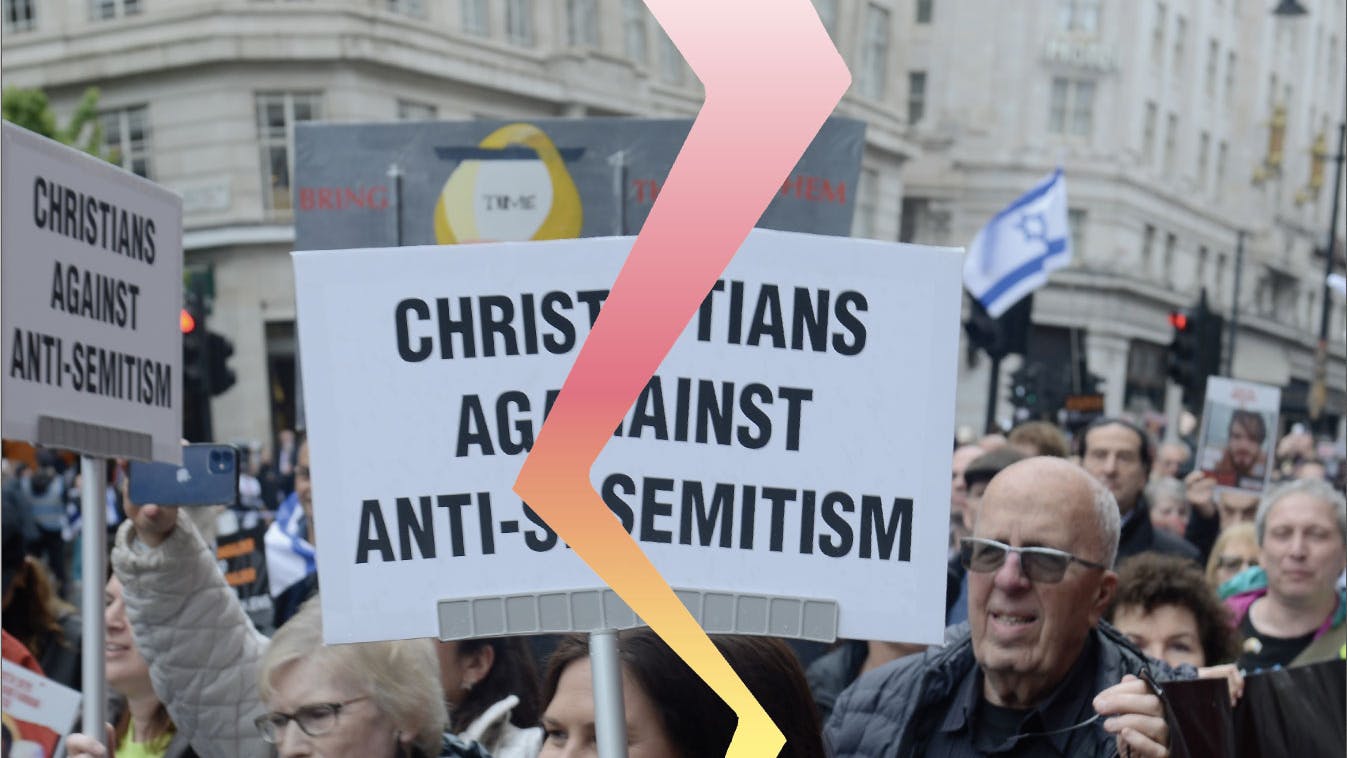
Since the rebirth of the modern State of Israel, one of the Jewish state’s strongest and most reliable allies have been evangelical Christians. From prayer groups to political advocacy and humanitarian aid, evangelicals have recognized the Jewish people as central to God’s redemptive story and have sought to bless the nation God calls “the apple of His eye” (Zech. 2:8).
But recent years have brought a shift. People who identify as evangelicals, including well-known media personalities, have become vocal opponents of Israel and the Jewish people, espousing age-old antisemitic ideas and libels. After October 7, these voices grew louder. Claims that once lived on the fringes of the internet suddenly entered mainstream debate: that Israel is corrupt; that Christian support for Israel is “blind;” and even that today’s Jewish state has no biblical legitimacy at all.
This movement is still a minority, but it’s a vocal minority. Israel now faces a new kind of challenge, not from secular critics or geopolitical rivals, but from inside a community of its greatest friends.
A Shift No One Expected
Historically, evangelicals have supported Israel for two primary reasons: Scripture and shared values. We value God’s covenants with Abraham, Isaac and Jacob. The prophets spoke of Israel’s restoration and role in God’s purposes. Jesus (Yeshua) Himself lived, ministered, died and rose within the Jewish story. For Bible believers, to stand with Israel has never been a political statement; it has been a theological one.

Yet now, some who call themselves evangelicals are rejecting that framework. Influencers such as Candace Owens, Tucker Carlson and others in the right-wing orbit frame Israel as, at best, an insincere ally who “gives nothing,” a nation whose troubles supposedly drain the West. Their rhetoric mirrors a growing online trend that blends anti-establishment politics with weak theology.
Secular opposition to Israel is nothing new. However, more evangelicals are falling prey to these ideas. The digital age has created a marketplace of competing moralities amid weak biblical literacy, and ideas about Israel are shaped less by Genesis or Isaiah and more by algorithm-driven outrage.
Argument One: “Modern Israel Isn’t the Israel of the Bible”
One of the most common claims is that the modern State of Israel has no connection to biblical Israel. Critics assert that modern Israel is secular, political and therefore spiritually irrelevant. A branch of Christians suggests that the Jewish people have forfeited their covenant blessings or that God has replaced them with the Church. Others simply conclude that ancient promises have expired. These arguments are classic supersessionism, or replacement theology, dressed in contemporary clothing.
The claim that “this isn’t the Israel of the Bible” collapses under even a brief encounter with Scripture. God’s covenant with Abraham is described as “everlasting” (Gen. 17:7). The prophets repeatedly affirm that God will restore His people to the Land, not because of their faithfulness, but because of His (Ezek. 36:22–24).
Ezekiel’s vision of the dry bones portrays a national restoration that begins physically before it matures spiritually (Ezek. 37). Modern Israel’s rebirth in 1948 aligns precisely with that pattern. God also allotted Abraham’s seed a specific Land with defined boundaries, which actually comprises a land mass larger than the current State of Israel (Gen. 15:18).
God remains deeply involved with Israel’s story, and He will call the nations to account for how they treat His people (Joel 3:2). Israel’s political complexity does not negate its biblical identity. If anything, it affirms that God’s prophetic plan continues to unfold in real time.
Argument Two: “Israel Is Morally Corrupt or Dangerous to the West”
The second major argument is political rather than theological: that Israel is either immoral or a strategic burden.
This rhetoric intensified after the October 7 massacre, with critics accusing Israel of being a destabilizing force, a drain on American resources or even the aggressor in its own war for survival. In November, American conservative political commentator Tucker Carlson endorsed criticizing the US relationship with Israel “because it’s insane and it hurts us. We get nothing out of it.”
The facts tell a different story.
Israel is the Middle East’s only liberal democracy, a center of innovation, humanitarian response and freedom of worship for Jews, Christians and Muslims alike. The US–Israel partnership provides critical intelligence, groundbreaking defense technology and global diplomatic cooperation, benefits that far exceed the assistance involved. Israel has thwarted terror plots that would have threatened Western nations, pioneered lifesaving medical developments and offered humanitarian aid in conflict zones worldwide.
Far from being a burden, Israel is one of the United States’ most reliable and mutually beneficial allies.
But beyond practicality, the moral dimension matters even more. Israel’s war after October 7 is not an abstract political dispute; it is a fight against a genocidal terrorist organization that explicitly declares its intention to destroy both Israel and the West. To accuse Israel for defending its citizens is not merely misguided, it reveals how deeply misinformation shapes the public conscience.
Is Christian Zionism “Blind Support”?
Perhaps the most common charge against Christian supporters of Israel is that they blindly defend Israel no matter the facts or circumstances, a critique that misunderstands what Christian Zionism is.
Christian support for Israel is not based on political infallibility but on biblical identity. It does not require agreement with every policy of an Israeli government or exemption from moral accountability. Christians can acknowledge Israel’s imperfections—just as we acknowledge those of every nation—while still affirming the covenant that God Himself established.
To support Israel biblically is not to fall into naïve partisanship. It is to recognize that God’s promises, purposes and character are woven through Israel’s story, and that blessing Israel is ultimately an act of obedience to Him.
What’s at Stake
The shift in evangelical perception reflects a deeper spiritual crisis: confusion about Scripture, the rise of ideology over theology and the erosion of moral clarity within the Church. The way Christians respond to Israel in this moment reveals what shapes their worldview: cultural trends or biblical truth.
For generations, evangelicals have understood that to bless Israel is to align with God’s heart. That calling has not changed. And in a time of rising hostility, misinformation and moral confusion, standing with Israel is not merely a political position, it is a spiritual one. As the cultural winds shift, the calling of Christian Zionism remains the same: not blind support, but biblical support, rooted in truth and aligned with the God who keeps His promises.
Related Resources




Discover Your Purpose and God’s Heart For You
In today's divided, turbulent world, it's essential for the Church to rediscover God's heart. Our free e-book, authored by a seasoned expert with three decades of experience in Israel, delves deep into the teachings of Jesus (Yeshua) to reveal God’s principles of love and purpose. Learn how embracing these truths can bring significance and impact to your life, even amidst chaos. Subscribe now to receive your free copy and embark on a journey of transformation.