Israel’s Place Among the Stars

Beware the Jewish space laser! The absurdity that Israel operates a deadly laser weapon circling the globe originated in a 2018 Facebook post to command an outsize share of social media attention, alleging that a Rothschild-owned space laser ignited the California wildfires. It did not, of course. But Israel is indeed in space.
Beyond the Horizon
When the Jewish state launched its first Ofek (Hebrew for “horizon”) intelligence satellite in 1988, it joined a tiny club of nations able to keep their spacecraft aloft in the blue yonder. Israel’s latest satellite, Ofek-16, was boosted heavenward in 2020. In Jewish understanding, the horizon is symbolic of vastness, hope and limitless possibilities. It communicates a sense of optimism and exploration. Though not found in the Bible, the name Ofek is taken from ancient Jewish texts and the concept is very biblical.
“I [wisdom] was there when He established the heavens, when He laid out the horizon on the surface of the ocean, when He placed the skies above…” (Prov. 8:27–28, HCSB).
“Sing to the Lord a brand new song! Praise him from the horizon of the earth…” (Isa. 42:10 NET).
“He drew a circular horizon on the face of the waters, at the boundary of light and darkness” (Job 26:10 NKJV).

Israel’s space platform comprises an electro-optical reconnaissance satellite capable of all-weather, night or day, high resolution imaging, with the Israel Aerospace Industries (IAI) responsible for designing and building the Ofek family of spacecraft and their launch vehicles. Compact, light and highly responsive, the satellite can modify its trajectory quicker than most space systems. Israel’s aim is not to put a weapon into space, but to provide its ground-based laser weapons with superior detection, intelligence and communication capabilities, connecting the sky and the ground through advanced data integration. In short, Ofek’s mission is early warning, giving Israel a defensive edge when foes release ballistic missiles.
Right to Left
Leave it to Israel to be different! True to form, the Jewish state is the only nation that launches from right to left. That means the trajectory is east to west, whereas all other spacecraft launch west to east, aided by the momentum from the earth’s rotation. Of course, launching to the west requires much more thrust power to hoist payloads into earth’s orbit, but Israel can’t afford the fallout of scattering space debris on their Muslim neighbors to the east. Instead, Jerusalem propels its projectiles over the Mediterranean, almost completely bypassing Africa and Europe until ascending over the Atlantic. Right to left…just like reading Hebrew.
Israel’s savvy tech and business sectors know that space is not just the final frontier, but the next arena for competition. There are whole new dimensions of business, diplomatic and military contests yet to be waged in the vast reaches of outer space. Israel’s quiet but growing strength beyond the horizon is already shaping how nations will defend themselves and conduct intergalactic business in the decades ahead.
Israel’s Elbit Systems recently added to the Jewish state’s space edge, producing Ofek-16’s Jupiter Space camera. This state-of-the-art imagine device boasts high spectral resolution of up to 50 centimeters (20 in.) from a height of 600 kilometers (311 mi.), which means Israel can now observe the whole Middle East and other regions with great precision.
Artemis Accords
In January 2022, Israeli Foreign Minister Yair Lapid announced that Israel would join the National Aeronautics and Space Administration (NASA) Artemis Accords: “We are moving toward a global and innovative future where countries mobilize resources for science and research and work together to advance space diplomacy.” Israel became the 15th signatory to the Artemis Accords, affirming its commitment to a common set of principles to guide cooperation among nations participating in 21st century space exploration.
Members of the accords pledge mutual support for peaceful purposes: rendering emergency assistance, registering space hardware, sharing scientific data, tracking orbital debris, deconflicting space activities and preserving outer space heritage. Israel Space Agency Director General, Uri Oron shared, “Today, space once again unveils its enormous potential and endless opportunities for Israel and for the entire world in the fields of innovation, technology and diplomacy.”
Meanwhile, Israel is going to the moon and beyond. In 2019, SpaceIL’s Beresheet (“in the beginning”) lunar lander became the first privately funded spacecraft to orbit the moon, making Israel the seventh country to achieve lunar orbit. Though it crashed on its attempted landing, the intellectual property survived. IAI licensed the Beresheet design to an American firm for NASA’s Commercial Lunar Payload Services program, bringing Israeli propulsion and guidance engineering to the next generation of American lunar landers.
With Them All the Way
The new space economy has rewritten all conventional rules. What matters most now is not which nation can build the entire rocket but which nation owns the part the rocket cannot fly without, “Components so specialized, so difficult to replicate, that the mission cannot fly without them,” a recent Times of Israel article explains. For a nation of just over ten million people shouldering a defense burden of 8.8% of GDP in 2024, a moon rocket was never the point for Israel. But becoming the supplier no moon rocket can do without makes every sense.

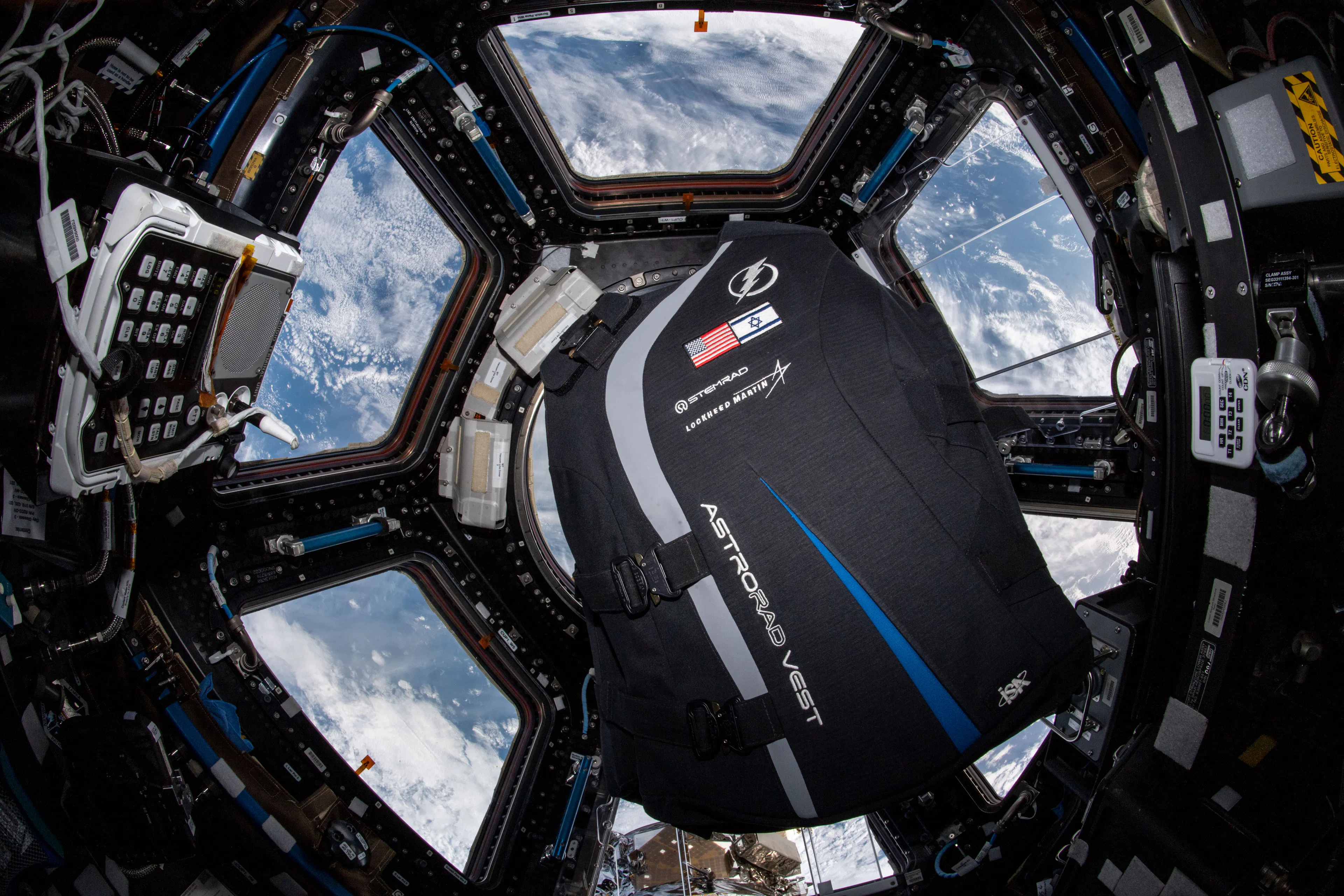
AstroRad, an Israeli-developed radiation protection vest for astronauts, went to space aboard Artemis I and continues to be nothing less than a lifesaver. This emblem of Israeli ingenuity was first tested on the German-made dummies of Artemis I. They then protected the three American and one Canadian astronauts who journeyed further into space than ever before. Through its technology and demonstrated care for humanity, Israel was with this space mission all the way.
AstroRad was developed by StemRad, an Israeli-American startup born in the aftermath of the Fukushima nuclear disaster. The startup recognizes that survival of nuclear first responders hinges on protecting the organs that matter most: bone marrow, lungs, breast tissue and colon. The space application required compressed polyethylene rather than lead with selective shielding of stem-cell-rich tissue that guards life while keeping the wearer highly mobile.
Israelis in Space
Of the 20+ Jews who have traveled beyond the horizon, two were Israelis. Most know of Colonel Ilan Ramon, a national hero and the first Israeli in space aboard 2003’s ill-fated Space Shuttle Columbia. The other hero is Eytan Stibbe, mission specialist on the 2022 Ax-1 mission to the International Space Station under the maxim “There is no dream beyond reach.”
You may have only thought of what’s above as the sky, or our atmosphere. Think again, space traveler, for as the astronauts know, it goes far, far beyond the horizon.
Related Resources




Discover Your Purpose and God’s Heart For You
In today's divided, turbulent world, it's essential for the Church to rediscover God's heart. Our free e-book, authored by a seasoned expert with three decades of experience in Israel, delves deep into the teachings of Jesus (Yeshua) to reveal God’s principles of love and purpose. Learn how embracing these truths can bring significance and impact to your life, even amidst chaos. Subscribe now to receive your free copy and embark on a journey of transformation.