Enemies among Allies: Shia vs. Sunni in Roaring Lion
The conflict in the Middle East is often oversimplified as a struggle between Israel and Iran, or between the West and the Muslim world. But beneath the surface lies another battle, one that has shaped the region for nearly 1,400 years.
Comprehending the difference between the two main branches of Islam—Sunni and Shia—helps to better understand many of the alliances, rivalries and wars shaping the Middle East today.
One Faith, Two Branches
Sunnis and Shiites have far more in common than what divides them. Both believe in the Quran, respect the Hadith (records of the oral traditions of Mohammed) and follow the Five Pillars of Islam: Shahada (profession of faith), Salat (daily prayers), Zakat (charitable giving), Sawm (fasting during Ramadan) and Hajj (pilgrimage to Mecca).
The primary difference between the two main branches does not stem from ideology but from a dispute over succession following Mohammed’s death in AD 632. Sunnis believed leadership should be chosen by consensus, not heritage, and supported Abu Bakr, Mohammed’s close companion and father-in-law, as his successor. Shiites supported Ali, Mohammed’s cousin and son-in-law, believing leadership should remain within Mohammed’s direct bloodline.
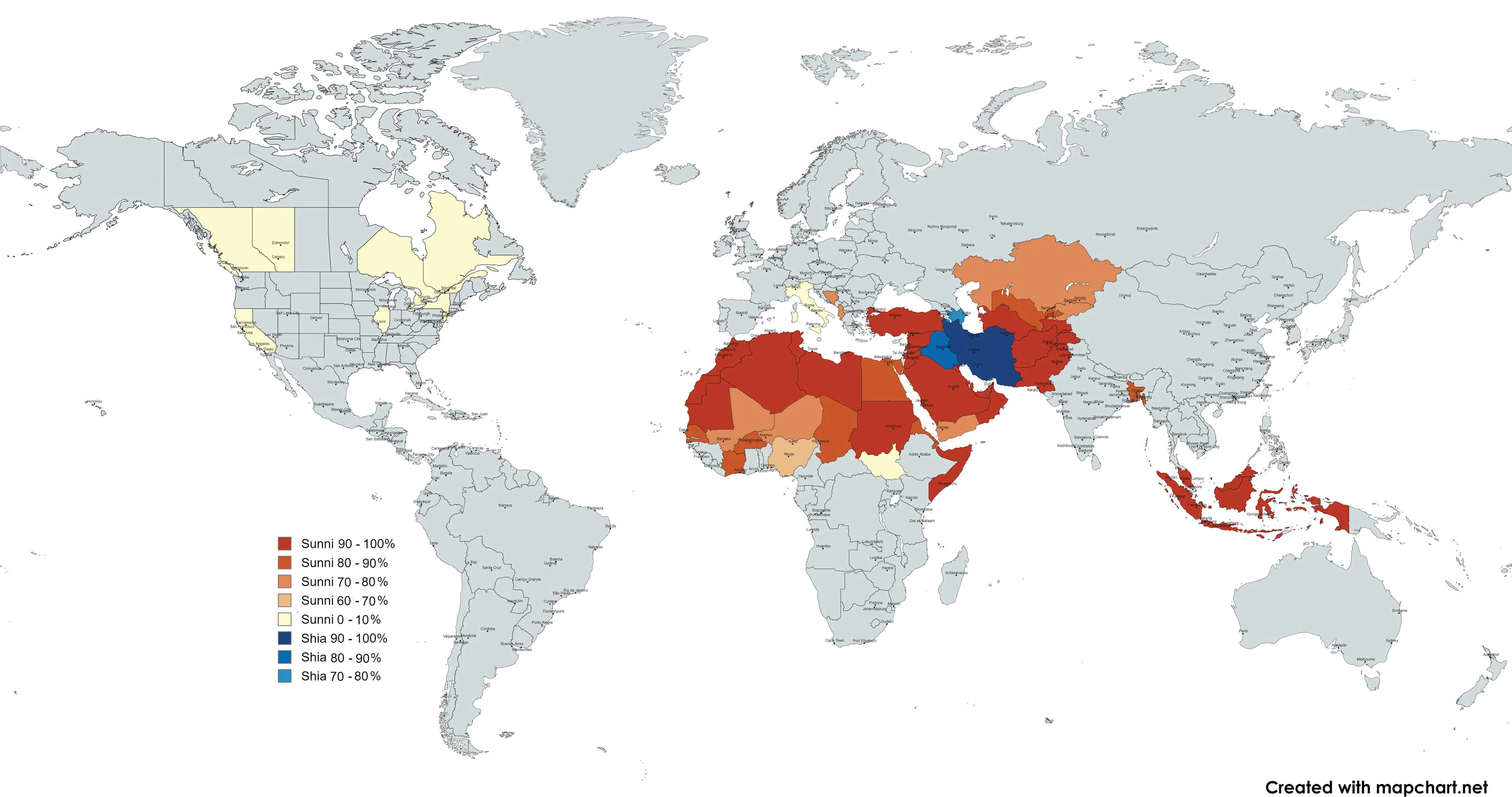
Today, roughly 85–90% of the world’s 1.6 billion Muslims are Sunni, while about 10–15% are Shia. Sunnis are the majority sect in most Muslim‑majority countries, including large populations in Asia, the Middle East and Africa. Shiites form majorities in Iran, Iraq, Bahrain and Azerbaijan, with significant populations in Lebanon, Yemen, Syria and parts of Saudi Arabia.
Roots of the Modern Divide
Sunnis recognize the leadership of the first four caliphs, or successors to Mohammed. These caliphs ruled through the Ottoman Empire—recognized as a caliphate for more than 400 years—until it collapsed after World War I. That loss prompted a Sunni backlash against Western influence, leading Egyptian schoolteacher Hasan al-Banna to establish the Muslim Brotherhood in 1928, the first major fundamentalist Sunni movement. Hamas later emerged as an offshoot of the Muslim Brotherhood.
Shiites, by contrast, recognize only the heirs of Ali as legitimate successors. Most Shia Muslims believe the Twelfth Imam, a descendant of Ali, disappeared in AD 874 and will one day return as the Mahdi, an Islamic messianic figure.
For centuries, Shiites believed they lacked legitimate political leadership. That changed in 1979, when Ayatollah Ruhollah Khomeini led Iran’s Islamic Revolution and established the first modern state ruled by Shiite clerics.
Iran and the Sectarian Divide
The 1979 Iranian Revolution marked a turning point. Khomeini transformed Iran into the world’s leading Shiite power and called on Shiites internationally to challenge Sunni monarchies and Western-backed governments.
Sunni rulers, especially in Saudi Arabia and the Gulf states, saw this as a direct threat. From that point on, the Middle East increasingly became a contest between Shiite Iran and Sunni Arab governments.
Iran began supporting Shiite movements and militias across the region, including Hezbollah in Lebanon, Shiite militias in Iraq, the Assad regime in Syria and the Houthis in Yemen. Iran has also supported Hamas, even though Hamas is Sunni, because of the shared hostility toward Israel and the US.
Saudi Arabia and other Sunni states responded by supporting Sunni governments and movements opposed to Iran, resulting in a series of proxy wars across the Middle East.
Iraq, Syria and the Rise of ISIS
The Iran–Iraq War of 1980–1988 was one of the first examples of this rivalry. Saddam Hussein, a Sunni ruler governing a Shiite-majority Iraq, feared Iran’s revolution would inspire Iraqi Shiites. As the hostilities raged, Saudi Arabia and other Sunni states backed Iraq against Iran, deepening sectarian tensions.
After the US invasion of Iraq in 2003 removed Hussein, Iraq’s Shiite majority rose to power. Iran quickly gained influence by supporting Shiite militias. Many Sunnis feared being pushed aside and turned to insurgent and extremist groups. In 2006, the bombing of a Shiite mosque triggered a wave of sectarian killings, with entire neighborhoods being divided between Sunnis and Shiites.
Out of this chaos arose ISIS, a radical Sunni movement that viewed Shiites as heretics. ISIS massacred Shiite civilians, destroyed shrines and sought to eliminate Shiite influence in Iraq and Syria. In response, Iran armed and funded Shiite militias to fight ISIS.
Syria became another sectarian battlefield after the 2011 uprising against President Bashar al-Assad. Assad belongs to the Alawites, a Shiite sect, while most Syrians are Sunni. Iran and Hezbollah supported Assad, while Saudi Arabia, Qatar and Turkey backed the Sunni rebel groups. What began as a civil war soon became a proxy war between Sunni and Shiite powers.
Beyond Iran and Saudi Arabia
The Sunni–Shia divide has also shaped other countries. In Lebanon, Hezbollah has become Iran’s most powerful proxy and a dominant force in the country. Many Sunni Muslims view Hezbollah as both anti-Israel and a Shiite force threatening Sunni influence.
In Yemen, the Houthis, a Shiite movement with ties to Iran, seized much of the country in 2014. Saudi Arabia responded by leading a Sunni coalition against them.
Sectarian tensions are not limited to the Middle East. In Western countries, Muslim immigrant communities sometimes divide along Sunni and Shiite lines, whether in demonstrations, mosques or student organizations.
At the same time, it is important not to oversimplify. Sunnis and Shiites have often lived peacefully together, intermarried and worshipped side by side. Many conflicts in the Middle East are driven as much by politics, power and ethnicity as by religion.
Why It Matters Today
The recent conflict involving Iran, Israel, the US and several Arab states cannot be understood simply as “Israel versus the Muslim world.” Beneath the surface is another struggle: Sunni Arab governments increasingly see Shiite Iran as a greater threat than Israel.
Iran’s backing of Hezbollah, Shiite militias, the Houthis and the Assad regime has alarmed Saudi Arabia, the United Arab Emirates, Bahrain and Jordan. As a result, these Sunni-led states have quietly moved closer to Israel and the US.
Recent Iranian threats and attacks against Sunni Arab states have only accelerated this trend. Rather than drawing the Arab world together against Israel, Iran’s actions have pushed many Sunni governments further into cooperation with Israel and the US.
The Sunni–Shia divide is therefore not merely an ancient theological dispute. It remains one of the most powerful forces shaping the alliances, rivalries and conflicts in the modern Middle East.
Related Resources



Discover Your Purpose and God’s Heart For You
In today's divided, turbulent world, it's essential for the Church to rediscover God's heart. Our free e-book, authored by a seasoned expert with three decades of experience in Israel, delves deep into the teachings of Jesus (Yeshua) to reveal God’s principles of love and purpose. Learn how embracing these truths can bring significance and impact to your life, even amidst chaos. Subscribe now to receive your free copy and embark on a journey of transformation.