Stories Behind the Shekel
It’s easy to ignore a ten agorot piece. After all, the least valuable Israeli coin in use today has zero buying power by itself. Yet there is a fascinating fact about this insignificant piece of aluminum, bronze and copper: it is the replica of a coin issued by Antigonus II Mattathias, the last Hasmonean king who reigned over an independent Jewish kingdom from 40 BC until his death in 37 BC.
The ten agorot piece isn’t the exception to the rule. Many of the coins in use by Israelis on a daily basis have interesting stories to tell.
In the Beginning
Before the advent of coins and later paper banknotes, goods were bought and sold under a system of weights and measures. In fact, shekel, the Hebrew word used today to describe the units of Israeli currency, is derived from the Hebrew verb “to weigh.” So, we can say that Israel’s modern currency traces its roots back to commerce in the pre-coin days.
The use of coins in the Middle East has been a relatively recent event. The general consensus is that they appeared around 600 BC, when the kingdom of Lydia, located in modern-day Turkey, minted the first official, government-sanctioned coinage
According to the Bank of Israel, the first coins that appeared in ancient Israel were minted when the Jewish people returned from Babylonian exile and were still under foreign rule. After that, with the exception of a brief period of independence under the Maccabees, coins would not be issued by an independent Jewish state until David Ben Gurion announced the birth of the State of Israel on May 14, 1948.
Unlike the coins of ancient Greece and later those of the Roman Empire—or even coins from modern nations—Israeli coins are unique in that they do not include images of rulers or famous Jews. This is just one more example of how life in the State of Israel remains rooted in its biblical foundation as Moses relayed God’s instructions when he told the people, “You shall not make for yourselves a carved image” (Exod. 20:4).
Transition from the British Mandate
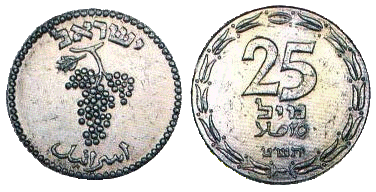
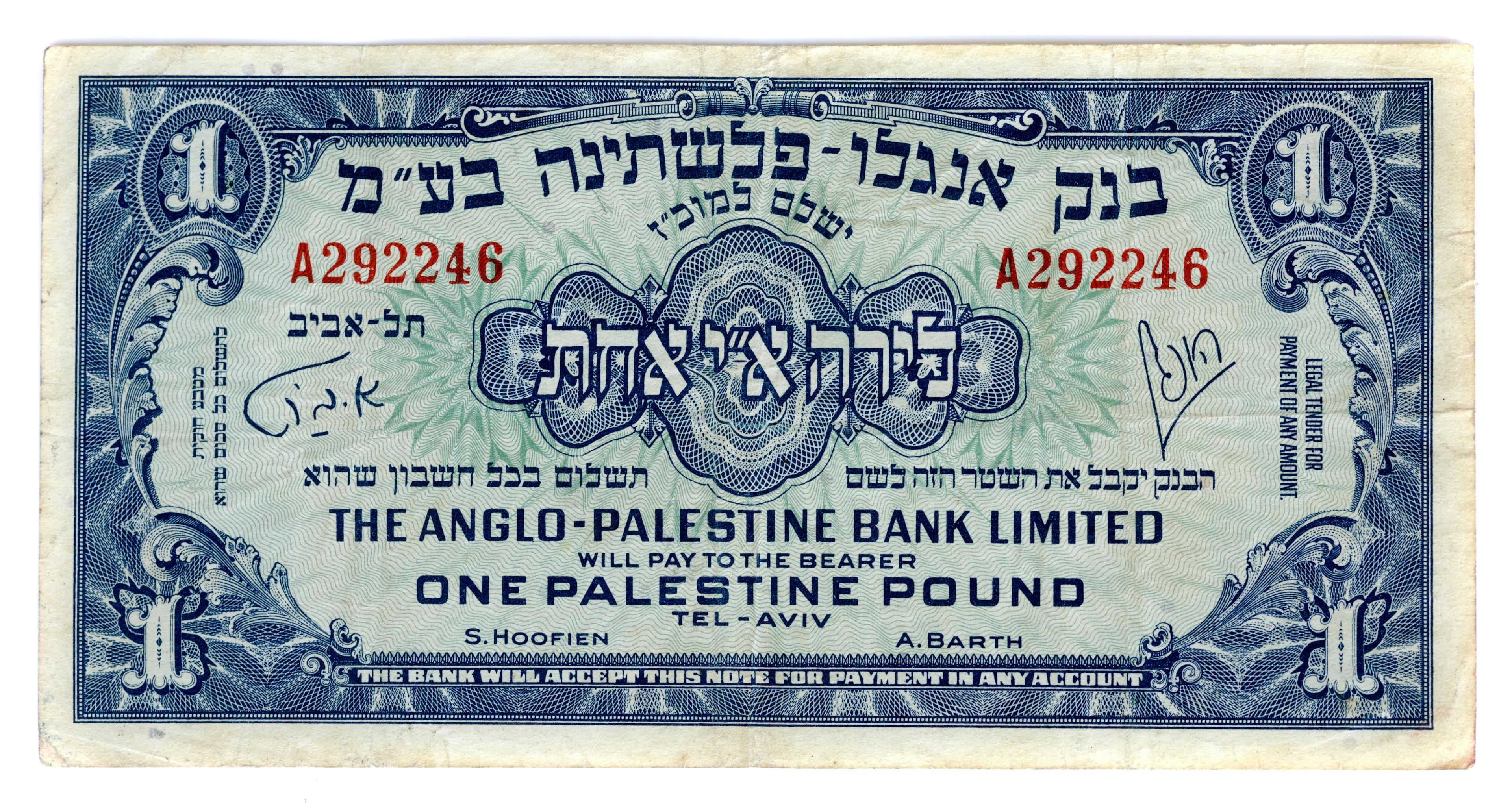
In the early days of statehood, Israel faced many challenges and did not immediately address its currency. The name “Palestinian pound,” a familiar one from the British Mandate, was retained for the next several years, with the Jewish Agency’s bank in London assuming responsibility for printing the banknotes. However, coins were in short supply and the new state almost immediately released its first coin: a 25 mil piece, whose name was also carried over from the Mandate period.
In June 1952, the Palestinian pound became the Israeli pound and the mil was replaced by the pruta, a Hebrew word meaning “a coin of lesser value.” The pruta was in circulation for the next eight years until the agorot was introduced in 1960. The Israeli pound, also known as the lira, was the nation’s currency until 1980.
The New Israeli Shekel
In 1980, the shekel replaced the mil and pruta. At that time, there were three agorot coins in denominations of one, five and ten. The 5 agorot coin, which was removed from circulation in January 2008, was an interesting one. It was the replica of a coin from the fourth year of the Jewish revolt against the Romans (AD 66–70), which showed a lulav (closed palm frond) between two etrogim (lemon-like citrus fruit), both of which are used during Sukkot (Feast of Booths) celebrations.
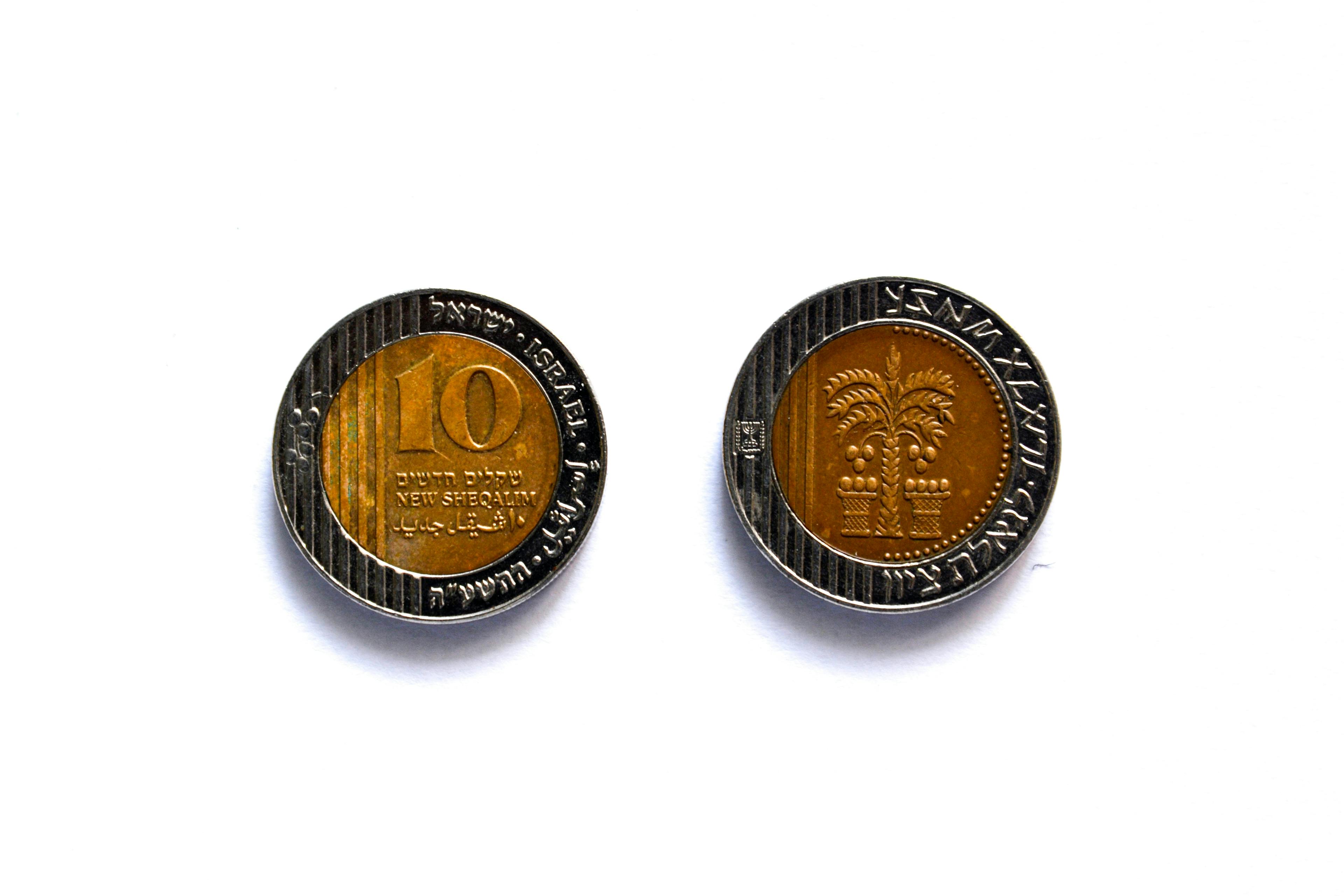
Change is almost certain in the world we live in and monetary systems are no exception. In 1985, when Israel adopted the “New Shekel” (₪), the 10 shekel was a banknote. Ten years later in 1995, it was replaced with the ₪10 coin. In keeping with Israel’s practice of using modern designs with historical significance, the ₪10 coin features the words, “For the redemption of Zion” in both the ancient and modern Hebrew alphabet along with a seven-leafed palm tree and two baskets filled with dates.
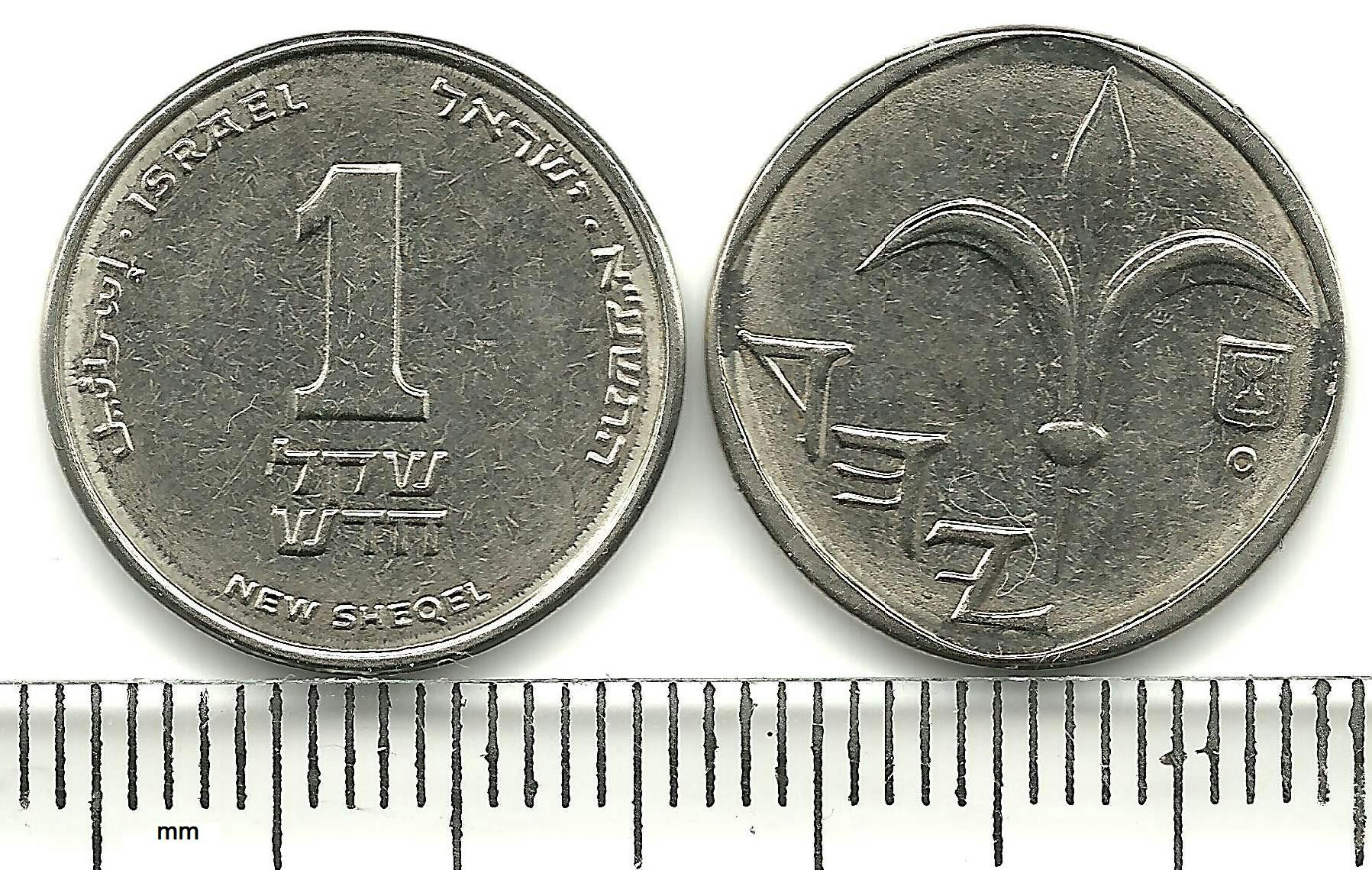
Another coin that can trace its history back thousands of years is the ₪1 piece, whose design originated from the period when an ancient Jewish script was in common use. The modern ₪1 takes its inspiration from a tiny silver coin discovered in Jerusalem, which had a lily on one side and an eagle with outstretched wings and the inscription “YHD” written in that ancient Hebrew script on the other. Drawing from the ancient design, the modern coin includes a lily and “YHD” inscribed on one side, while the numeral “1” and the name Israel, written in both Hebrew and Arabic, appear on the other side along with the issue date according to the Hebrew calendar.
The ₪2 piece is the newest of Israel’s coins as it was introduced in late 2007. Inspired by the Hasmonean kingdom, the design replicates a coin minted during the reign of Yehohanan (John) Hyrcanus I, who led the nation as high priest and king from 134 BC to 104 BC.
Finally, the ₪5 coin rounds out the six different units currently in circulation today. While it does not represent a coin from Israel’s ancient history, it does follow Jewish practice in that it does not include the image of a person but rather the emblem of the State of Israel with the capital of a column below, thus combining both the modern and ancient history of the Land.
Evidence of the Eternal Covenant
Today there are some who deny there was ever a Jewish presence on the Temple Mount, claiming that biblical accounts have no basis in truth. These attempts to rewrite history have been exposed by archaeological finds, including that tiny silver coin whose design inspired today’s ₪1 piece. The money we use to buy our coffee and burekas is just one more piece of evidence pointing to the Jewish presence in this land and the faithfulness of the God who promised Abraham “for all the land which you see I give to you and your descendants forever” (Gen. 13:15).
Related Resources



Discover Your Purpose and God’s Heart For You
In today's divided, turbulent world, it's essential for the Church to rediscover God's heart. Our free e-book, authored by a seasoned expert with three decades of experience in Israel, delves deep into the teachings of Jesus (Yeshua) to reveal God’s principles of love and purpose. Learn how embracing these truths can bring significance and impact to your life, even amidst chaos. Subscribe now to receive your free copy and embark on a journey of transformation.