Turn the Other Cheek
Download PDF Version
I stood facing a congregation in a large city in South Africa. It was six months after October 7. Six months into a war that would become the longest conflict in Israel’s modern history. Six months into accusations of Israel committing genocide, employing excessive force and purposefully targeting women and children. My audience hadn’t bought into the propaganda though. Those who sat facing me had done their homework. They knew the truth.
Still, when it was time for questions, a young man stood up. “I stand with the God of Israel. Yes, Hamas is evil. But Jesus [Yeshua] taught us to love our enemies (Matt. 5:44), to turn the other cheek (Matt. 5:39). And Israel does the opposite. They’re fighting their enemies instead of praying for them. They’re definitely not turning the other cheek.”

There it was: the notion that Israel’s actions of self-defense violate the teachings of the Gospel. According to this argument, Israel should have responded to the most brutal attack since the Holocaust—and to the ongoing threat of annihilation from Iran—by overlooking the bloodshed and the promises of more to come, embraced its enemies, answering in the opposite spirit. In short, Israel should have capitulated compliantly rather than take up arms to defend itself.
Make no mistake. The argument is far from a fringe thought coming from a lone Christian, neither does it relate to Israel exclusively, although recently it has been applied to the Jewish state with increasing frequency. At the heart of the young man’s question lies a niggling disparity that Christians around the world have pondered for generations and theologians have debated even longer: how do we reconcile Jesus’ teachings of forgiveness, forbearance, meekness and turning the other cheek with demands for justice, self-defense and ultimately war? Does His instruction to love our enemies automatically disqualify the use of force to defend ourselves or our loved ones from harmful or deadly wickedness? And what does this mean for governments in times of just war, when they must act in self-defense, restrain deadly evil or bring those who harm their nation to justice?
A Slap, Not a Sword
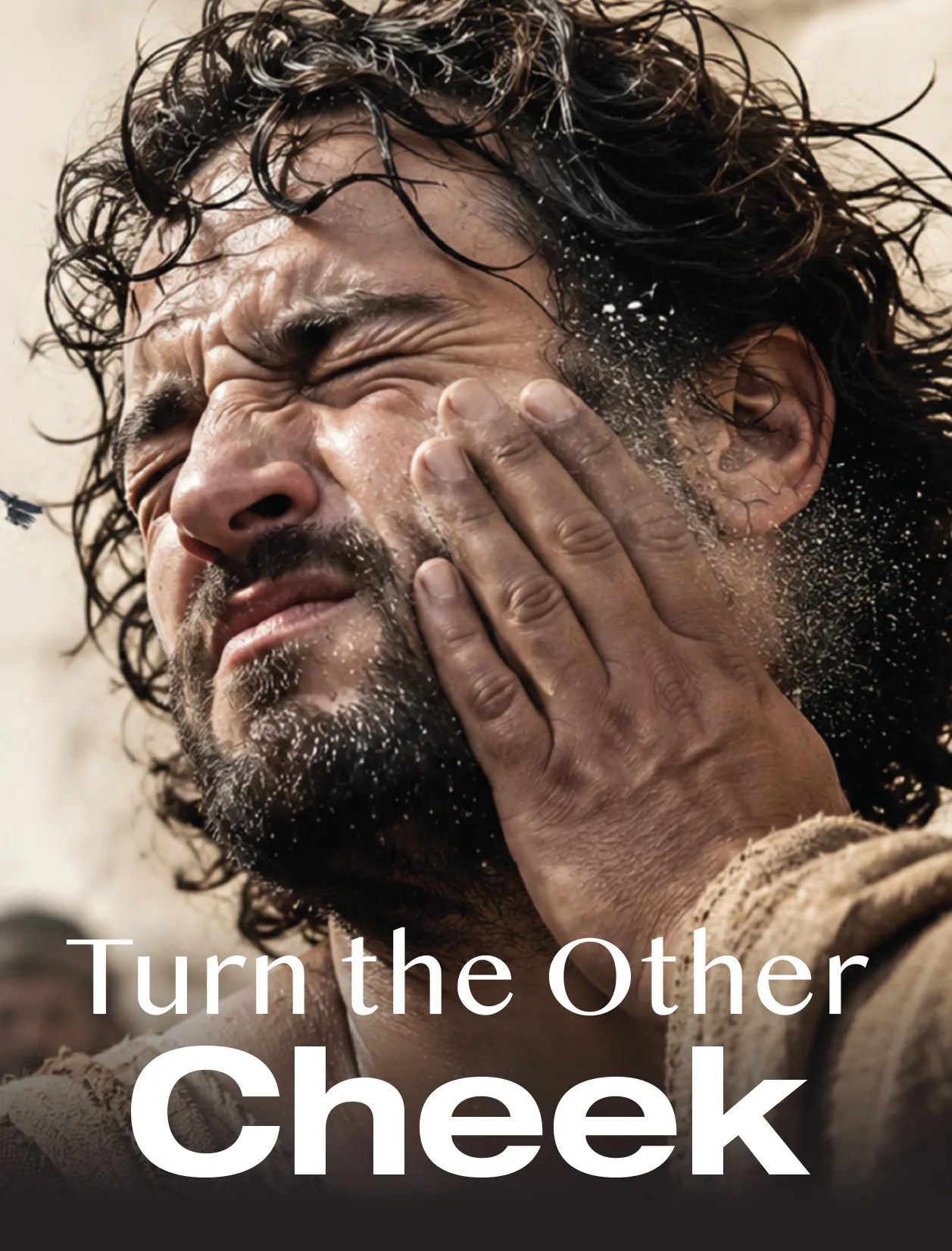
The question of Jesus’ stance on the use of force comes to a head in the Sermon on the Mount, where He proclaimed a blessing on the “peacemakers, for they shall be called sons of God” (Matt. 5:9) and taught, “I tell you not to resist an evil person. But whoever slaps you on your right cheek, turn the other to him also” (Matt. 5:39).
At first glance, the conclusion seems cut and dried. However, reading Scripture through our modern Western lenses without understanding the culture, tradition and context of the world in which Jesus and His audience lived often causes confusion and misinterpretation. As a result, we often see allegory or metaphor in scenes that were common knowledge for His audience but forgotten details of antiquity to us. Such is the case with turning the other cheek.

In first-century Jewish culture, a slap on the right cheek was a calculated insult meant to humiliate someone considered inferior. A master would, for instance, slap his servant, or a Roman soldier a Jewish civilian. The slap would be delivered with the back of his hand, communicating tremendous contempt.
In short, a slap on the right cheek was something Jesus’ audience encountered in their day-to-day existence, not a metaphor He used for a threat of bodily harm. By calling on His audience to turn the other cheek, Jesus was instructing them to shun offense and resist the desire to react personally when their pride or dignity had been insulted, not to submit passively as someone slaughtered them or their loved ones.
So, if the Sermon on the Mount doesn’t offer the godly golden rule regarding the use of force, self-defense and ultimately just wars, what does?
A Man of War
The Bible often speaks of God in military terms. For instance, Adonai Tzavaot, the “Lord of Hosts,” one of His names, occurs more than 230 times in Scripture. The literal Hebrew meaning is “Lord of Armies,” with tzava meaning army and tzavaot being the plural. Interestingly, the IDF, or Tzva HaHagana LeYisrael, shares part of its name with that of the God who promised to go before the army of Israel in battle. Adonai Tzavaot thus identifies God as the Lord of multiple armies or the Lord of the Angel Armies.
God similarly describes Himself in military terms, even as a military commander or warrior. Examples include Exodus 15:3, “The Lord is a man of war; the Lord is His name,” Joshua 5:14, “…as Commander of the army of the Lord I have now come” and Psalm 24:8, “Who is this King of glory? The Lord strong and mighty, the Lord mighty in battle.”
Warfare is unmistakably a central Old Testament theme, and God clearly does not shy away from the use of force. But there’s a crucial caveat. Violence is never arbitrary and power is never employed to fulfill bloodlust, satisfy vengeance or prove prowess. God’s justice, mercy and desire for the restoration of humanity to Himself often requires decisive, deliberate and yes, even violent action against the enemy. Scripture makes it clear that the Lord of Angel Armies rises up like a man of war only to confront and uproot evil.
Ultimately, God’s warfare flows from His justice. He rises up to “do justice to the fatherless and the oppressed” (Ps. 10:18). And when Isaiah envisions God going forth “like a mighty man” stirring up “His zeal like a man of war,” His purpose is establishing justice and righteousness (42:13).

And the Prince of Peace?
But what about Jesus? Surely the Prince of Peace offers a more passive, pastoral side of the godhead in the New Testament than the Lord of Hosts in the Old?
Jesus Himself dispels that notion. He didn’t come to destroy the Law and the prophets but to fulfill them (Matt. 5:17), not to contradict the Hebrew Scriptures but to show firsthand how to interpret and live them out daily. Moreover, “I and My Father are one” (John 10:30), Jesus taught, adding, “He who has seen Me has seen the Father” (John 14:9b). Scripture also affirms God’s unchanging nature (Mal. 3:6, James 1:17) from the dawn of time to its final chapters, through testaments, covenants and generations.
The bottom line? The Lord of Hosts who doesn’t shy away from decisive action against evil from Genesis through Malachi is the Prince of Peace from Matthew through Revelation—and beyond. And Jesus’ mission in the New Testament clearly mirrors God’s in the Old: justice, mercy and the restoration of humanity by confronting and uprooting evil.
When corruption desecrated the Temple, Jesus didn’t respond with passive resistance. He made a whip and forcefully drove out those who had turned His Father's house into a marketplace (John 2:13–16). His actions were deliberate, forceful and unapologetic.
Jesus never condemned those whose vocations required the use of deadly force. When a Roman centurion—a military commander wielding authority over life and death—approached Him, Jesus marveled at his faith and proceeded to help (Matt. 8:10). The centurion’s profession was never presented as incompatible with following God. Similarly, when soldiers came to John the Baptist asking what repentance required, he told them to conduct themselves with integrity within their calling, not to abandon military service (Luke 3:14). Clearly, participation in forceful action isn’t inherently sinful.
On the eve of His arrest, Jesus instructed His disciples: “He who has no sword, let him sell his garment and buy one” (Luke 22:36). The sword—the first-century equivalent of today’s sidearm—was explicitly permitted for defense.
The list goes on, but the point stands: through His words and actions, Jesus communicated that confronting and uprooting evil entailed active engagement, and at times, force.
A Question of Audience
There’s another crucial distinction to make. Jesus most often taught individuals, not governments. His message wasn’t pitched at a national but rather an interpersonal level. The majority of the Gospels recount His words to specific people facing personal choices: a rich young ruler, a woman caught in adultery, disciples wrestling with forgiveness, tax collectors seeking redemption, all of which is instruction applicable to His individual followers on how to interact with their fellow human beings in a fallen world. Yet we routinely take teachings aimed at individual conduct and apply them wholesale to national governance. “Turn the other cheek” becomes foreign policy. “Give to everyone who asks” becomes fiscal responsibility. “Judge not” becomes criminal justice reform. But we can’t conflate the two. Jesus wasn’t offering a blueprint for how governments should administer justice among nations. His focus was personal holiness, not national policy.
God’s guidance for nations appears elsewhere in His Word. The apostle Paul teaches that God grants governments and earthly leaders the authority to punish wrongdoing and uphold justice. “For he is God’s minister to you for good. But if you do evil, be afraid; for he does not bear the sword in vain; for he is God's minister, an avenger to execute wrath on him who practices evil” (Rom. 13:4). Whether governments fulfill this divine responsibility to restrain evil and maintain social order under just laws is a legitimate question. However, it’s not the central issue here. Paul’s emphasis is clear: God established human governments to administer justice among nations and between citizens and civil authorities. These leaders are authorized to use force when necessary to restrain evil and hold lawbreakers accountable. Notably, Paul never suggests that governments should simply turn the other cheek when confronting wrongdoing.
Jesus acknowledged this principle, affirming the legitimacy of earthly governments bearing the sword: “If My kingdom were of this world, My servants would fight…” (John 18:36a). His meaning is significant: if His kingdom operated according to earthly principles, His followers would take up arms in His defense. The implication is that worldly kingdoms may rightly engage in combat when the cause is just and circumstances demand it.
Peace, Peace
The world currently experiences the highest levels of armed conflict in modern times, leading datasets say. We see the evidence everywhere. News headlines and social media feeds bear bloody witness to the unspeakable tragedy, heartache and suffering war leaves in its wake. Nobody can face such an agonizing reality without pleading, “Lord, peace!” Moreover, such carnage can make us question how the Prince of Peace can also be the Lord of Hosts, a man of war.
Perhaps the problem is that we’ve become lost in translation. We see the suffering and believe the absence of war will equal peace. We see mediators negotiate for ceasefires and hope they’ll prove peacemakers who will silence the warplanes and missiles. But peace isn’t the absence of conflict.
The biblical word for peace, shalom, is derived from the root shalem, which encompasses wholeness, restoration, prosperity and completeness alongside perfect peace. True shalom is thus not the mere absence of war; it’s the absence of evil itself.
The conflict we see today is ultimately the physical manifestation of a spiritual reality: the fall of man, enmity, sin, brokenness and an enemy that kills, steals and destroys. This is the evil the Lord of Hosts confronts. This is what the Prince of Peace rises up against like a man of war. And He calls on His followers to do the same.
Being a peacemaker doesn’t mean passivity in the face of evil for the sake of avoiding conflict. Yes, we should love our enemies. Yes, we should pray for them. But loving them doesn’t mean tolerating their wickedness. Peace isn’t preserved by accommodating evil, but by resisting and overcoming it. Many of the greatest biblical peacemakers were God-appointed warriors. Think of Joshua, David and Gideon, all chosen to confront evil by engaging in the conflict necessary to establish godly shalom.
This is the calling we carry as His representatives: to fight the good fight, to stand against evil until He returns and we finally experience perfect peace, His peace, forever. The Kaddish, a central Jewish text recited daily, captures this hope: “May the One who makes peace in His high heavens, make peace for us, for all Israel, and for all who dwell on earth, and let us say: Amen.”
We long for the day when the Prince of Peace brings true shalom, when swords are beaten into plowshares and war is no more. Until that day, we do what Scripture commands: love our enemies and stand against evil.
Bibliography
BibleHub. “Hebrew Lexicon: Shalom (H7965).”
Peace Research Institute Oslo (PRIO). “UCDP Sharp Increase in Conflicts and Wars.”
Prince, Derek. War in Heaven: God’s Epic Battle with Evil. Chosen Books, 2003.
Uppsala University. “UCDP: Sharp Increase in Conflicts and Wars.”
Related Resources





Discover Your Purpose and God’s Heart For You
In today's divided, turbulent world, it's essential for the Church to rediscover God's heart. Our free e-book, authored by a seasoned expert with three decades of experience in Israel, delves deep into the teachings of Jesus (Yeshua) to reveal God’s principles of love and purpose. Learn how embracing these truths can bring significance and impact to your life, even amidst chaos. Subscribe now to receive your free copy and embark on a journey of transformation.