Globalized: When the Intifada Came to France
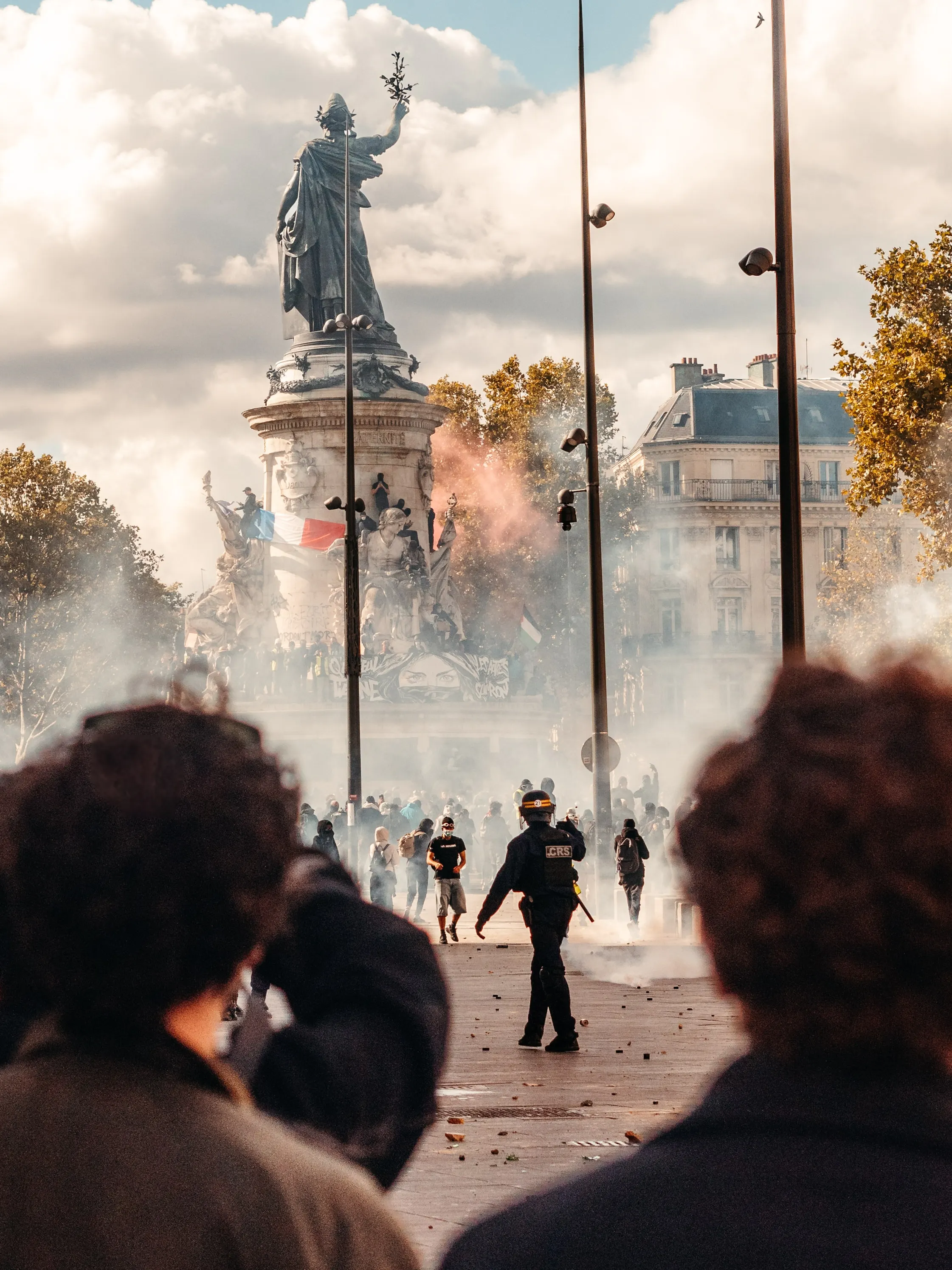
On the evening of Saturday, October 17, a bus stop burned at the foot of the great bronze monument at Place de la République in Paris. In one of the most widely shared photographs of the night, a protester stands before the flames with a flag held high. Of all the flags he could have carried through Paris, he chose the flag of Palestine.
What does a flag from a conflict thousands of miles away have to do with a protest about French classrooms and fuel prices?
From Classrooms to Chaos
The unrest began with genuine grievances. Since September, French high school students had blockaded schools over teacher shortages, overcrowded classrooms and crumbling buildings. Meanwhile, fuel prices had soared since the US–Iran war began earlier this year. On October 17, students, labor unions and veterans of the Yellow Vest movement took to the streets together. The Interior Ministry estimated that some 550,000 people marched nationwide, most of them peacefully.
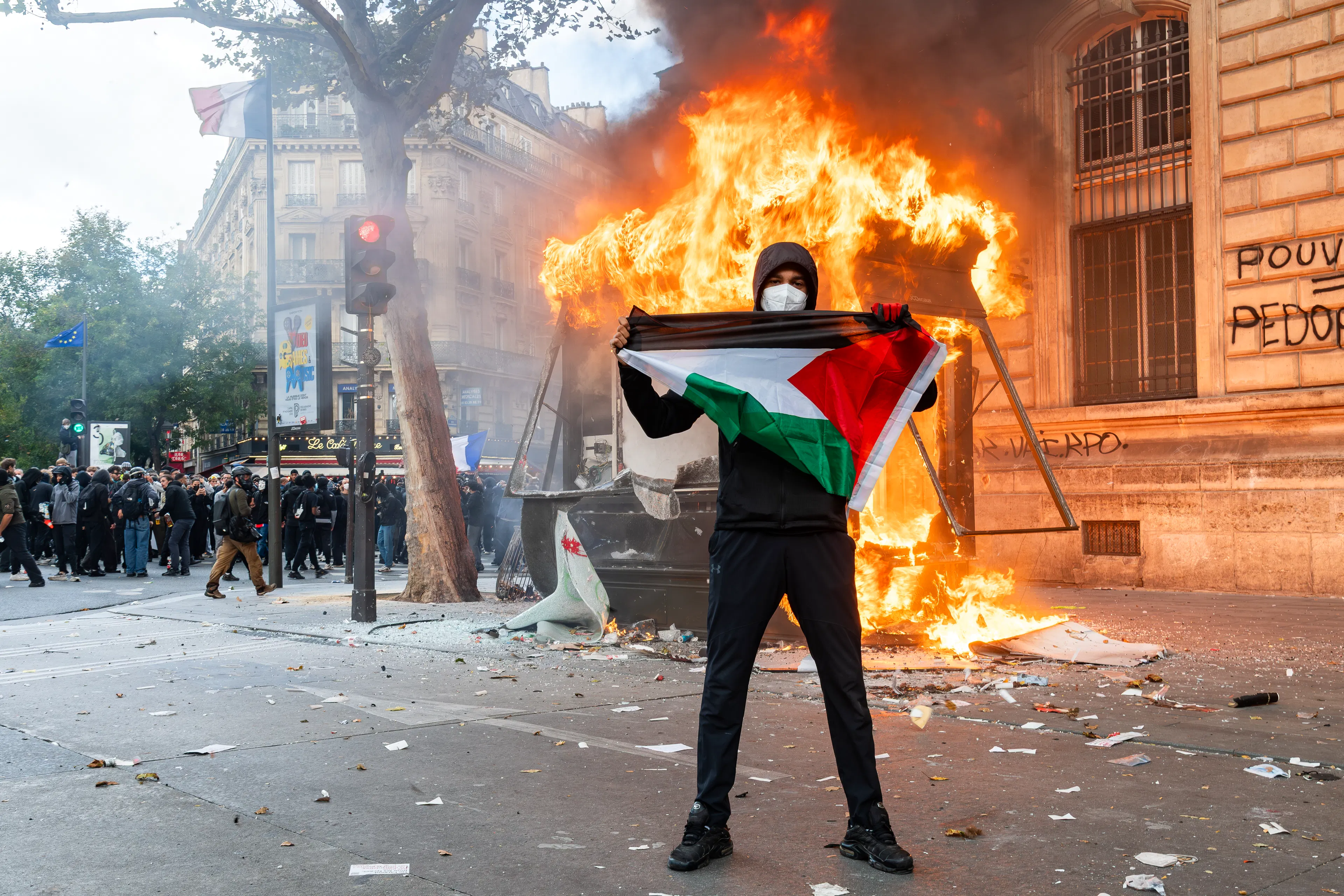
Then night fell. In Limoges, masked rioters broke into the 143-year-old town hall and set it alight until its clock tower collapsed into the flames. In Marseille, they forced their way into city hall. In Paris, they attacked media offices and methodically broke open shop after shop. By the end of the weekend, some 2,400 people had been arrested, more than 600 police officers and emergency workers had been injured and thousands of businesses lay damaged or looted.
None of this would put a single extra teacher in a classroom or bring down the price of a liter of fuel. Prime Minister Sébastien Lecornu spoke of “disorder organized in an unprecedented way.” Yet throughout the chaos, one symbol kept appearing.
One Flag, Every Protest
According to the Jewish Telegraphic Agency, Palestinian flags and keffiyehs were a recurring motif in most of the violent protests, vandalism and looting. In Marseille, Bruno Benjamin, who heads the local branch of CRIF, the umbrella body of French Jewish institutions, reported that many marchers carried Palestinian flags and chanted “Intifada.” Former French lawmaker Meyer Habib described Place de la République as “flooded” with them.
The flags did not appear by accident. HonestReporting has traced how pro-Palestinian groups such as Urgence Palestine and EuroPalestine backed the student protests and helped bring Palestinian symbols into marches supposedly about French schools. Online, activists posted the Palestinian and French flags side by side with the words “Free Paristine” and the caption “Intifada Globalized.”
Perhaps it was meant as a joke. Regardless, it was an eerily accurate description.
What the Word Means
For three years, crowds in Western capitals have chanted “Globalize the intifada.” Many dismissed the slogan as heated rhetoric. But the word carries a history. Intifada is Arabic for “uprising,” and it is the name given to the two waves of Palestinian terror that began in 1987 and 2000. Israelis remember them as years of suicide bombings, shootings and stabbings. To globalize the intifada is to call for that method to be carried far beyond Israel’s borders.
Those who chant it know exactly what it means. On October 7 this year, the third anniversary of the Hamas massacre, several hundred people gathered with Palestinian flags in Berlin, among them Greta Thunberg. According to the Jüdische Allgemeine, the crowd chanted for an “Intifada Revolution.” On the day Jews mourned their dead, the flag was raised to celebrate the means by which they were killed.
Consider, too, that the flag flew over burning town halls more than a year after France officially recognized a Palestinian state. If the cause were truly a state alongside Israel, France had already granted it. The flag in the streets of Paris was not asking for a state. It has become the banner of choice for those who want to tear down the order of the West, with Israel as their first target.
They Told Us
Some years ago, British author Douglas Murray was asked at a cocktail party what he thought ISIS wanted. Murray was baffled. ISIS had clearly published its goals for all the world to see. Their bloody end game was clear. Yet when he explained to his companion that the group wanted a worldwide caliphate, the guest frowned and said he didn’t really see that. The West, Murray observed, struggles to believe that its enemies mean what they say.
Israel’s experts have told us plainly. Weeks after October 7, Professor Kobi Michael of the Institute for National Security Studies urged the world to listen carefully to the leaders of Iran, Hamas, Hezbollah and their allies. “They admit that the destruction of the State of Israel is the first phase. The second phase will be Berlin, Paris and New York. And October 7 stands as proof that there is no difference between their words and their actions.”
Paris. He named it nearly three years ago.
Col. (ret.) Grisha Yakubovich, the last Israeli mayor of Gaza City, issued the same warning in early 2024. “We are fighting for us and our people, of course. But the Jewish state serves as the final frontier to Europe and beyond. In the bigger picture, we are defending the Jewish, Christian, Western world and the values you and I hold dear.”
Israel Warned Us
“You can accuse Hamas of many things,” a friend confided after October 7, “but not of hiding their true colors. They’ve told us for years what they wanted. The least we could’ve done was take them seriously.”
The same is true of those who carried the Palestinian flag through the streets of France. For three years, they told us what they wanted. On October 17, they showed us.
Israel has stood on that front line since October 7, burying her sons and daughters and warning that the fire would not stay in the Middle East. Much of the world answered with accusations and arms embargoes.
For those of us who stand with Israel, the riots carry a sobering lesson and a clear calling. The lesson is that Israel’s warnings were accurate all along. The calling is to take the enemy at his word, to see Israel’s fight for what it truly is and to stand with her without apology, because her fight is ours too.
The intifada isn’t coming to the West. It is already here.
Related Resources



Discover Your Purpose and God’s Heart For You
In today's divided, turbulent world, it's essential for the Church to rediscover God's heart. Our free e-book, authored by a seasoned expert with three decades of experience in Israel, delves deep into the teachings of Jesus (Yeshua) to reveal God’s principles of love and purpose. Learn how embracing these truths can bring significance and impact to your life, even amidst chaos. Subscribe now to receive your free copy and embark on a journey of transformation.